Books, authors, and literary shenanigans.

Month: November 2022

“The body of the young woman lay beside the controls like a figure in a tableau sculpture, the foam forming a white fleece around her naked shoulders.”

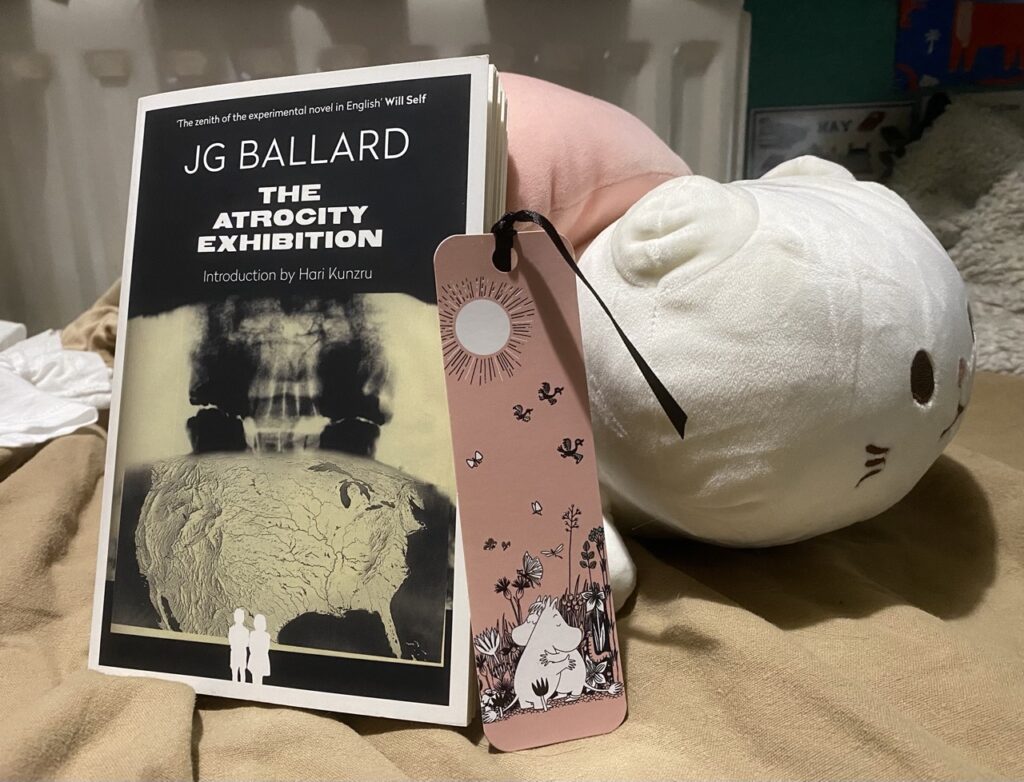
The Atrocity Exhibition, J.G.Ballard, Fourth Estate 2014

Compiled after the tumultuous 1960’s had concluded, Ballard’s The Atrocity Exhibition compiles short stories, referred to by Ballard as “condensed novels”, that explores themes of the celebrity, the world we inhabit and how it changes around us, and the shifting media landscape to name but a few. Described as “profound and disquieting” in the novel’s preface, Ballard’s text seemed to me to be a search for meaning following the violence and sense of the unknown that the 60s has become synonymous with. Ballard notes that “at the end of each chapter I have provided a few notes” that are intended to make the text more accessible to those who may not have a sense of the contextual background of some of the real-world figures mentioned throughout the text. I certainly benefited from this addition; however, I cannot help but wonder if it is wholly necessary given the surreal nature of The Atrocity Exhibition.

“This is Travern’s hell. You can see he’s trying to build bridges between things – this Kennedy business, for example. He wants to kill Kennedy again, but in a way that makes sense.”

(Ballard, 2014, pg. 50)

The most compelling overarching narrative of The Atrocity Exhibition for me was Ballard’s dissection of celebrity culture and the way we view and relate to people who have achieved celebrity status. In ‘The ‘Soft’ Death of Marilyn Monroe’, Tallis uses geometry as a lens to reconstruct Monroe’s death, echoing the media’s obsession with her body. Perhaps the ultimate Hollywood celebrity, Ballard himself refers to her as “the first and greatest of the new-style film goddesses”, and reflecting on her “spectacular success as the world embraced her flawed charm” (pg. 61). In his commentary “But isn’t Kennedy already dead?”, Ballard notes how “Kennedy’s assassination presides over The Atrocity Exhibition”, and that in a way “the book is directly inspired by his death” (2014, pg. 52). Traven and “his many selves” repeatedly explore and restage the deaths of these major celebrities, muddling and contorting our view of the celebrity throughout the novel. This felt extremely poignant to me as a reader in 2022 given recent history such as the ‘Me Too’ movement and the harrowing unearthing of actions and events surrounding the figure of Jeffrey Epstein, both of which are evoked in the sexual recreations Ballard continously returns to throughout the text. The intense themes of sex, and the sexualisation of the female characters in Ballard’s text also emphasises the public’s view of celebrities, given the obssession that circulates the bodies and sex lives of stars even in the modern day, not to mention the rumoured relationship between JFK and Monroe, gossip that gripped America back in the 60s. The relationship between the celebrity and the public is now more fluid than ever given the advances of technology in the 21st century and the presence of social media. In a flash, a celebrity’s controversial comments can be plucked from their back catalogue and presented for all to see. These kinds of events that can lead to the sudden down fall of public figures, such as the leaked WhatsApp conversations between Tory MPs during Boris Johnson’s term as Prime Minister, is the exact terrifying future that Ballard predicts throughout his text. Thanks to an online presence, no one can ever truly die, nor escape the sins of their past, which Ballard’s shifting protagonist seems desperate to get to the bottom of. Traven knows that Kennedy and Monroe “have died” but believes them not to have “been put to rest”. This aspect of Ballard’s writing poses an interesting question to those of us reading through the modern lens, I personally would love to know what Ballard would think of world events in 2022, and which events Traven would be restaging now if he were to exist.

“Through this glaciated silence the white walls of the apartment fixed arbitary planes. She began to dress, aware of his eyes staring at her body.”

(Ballard, 2014, pg. 55)

In the accompanying ‘Authors Note’ added to the 4estate edition in 2001, Ballard suggests that the reader approach the text by picking out sections that seemed appealing to them and to read any nearby paragraphs that intrigue them. While I’m sure Ballard himself is in no doubt the number one authority on his own novel, I personally found that a linear reading of The Atrocity Exhibition worked well for me, with the journey of the ever-shifting supposed protagonist making sense despite the mutating landscape of Ballard’s world. Even the shifting of the protagonist’s name from Travis, Travers, Traven, Talbot, and Talbert was not something I found confusing, more a method of Ballard’s writing that fit with the developing desolation of the world the protagonist inhabited. Although I can see why reading the stories separately is possible, and absolutely a good suggestion for anyone struggling with the content of the text, I do not think this would lead to a superior reading. 

“Marilyn’s pitted skin, breasts of carved pumice, volcanic thighs, a face of ash. The widowed bride of Vesuvius.”

(Ballard, 2014, pg. 56)

Ballard’s compilation is one that tests the reader, holding your hand while also encouraging you to throw logic to the wind and delve into a world of questions while being prepared to not necessarily find answers. The ever-shifting identity of Travis (etc) poses a fascinating reflection of the public who absorbed the media output of the 1960’s, and how they could easily lose themselves in the tumultuous travesties that appeared to go on and on. Although it took some getting used to, Ballard’s experimental and avant-garde style continued to impress me throughout and still felt as relevant to a reader in 2022 as I am sure it did in the 70s upon its release. While it may not be for everyone, I would very much encourage anyone looking to try something different to give The Atrocity Exhibition a go. 

“But she seemed miles away, a dream figure, inaccessible and unreal”

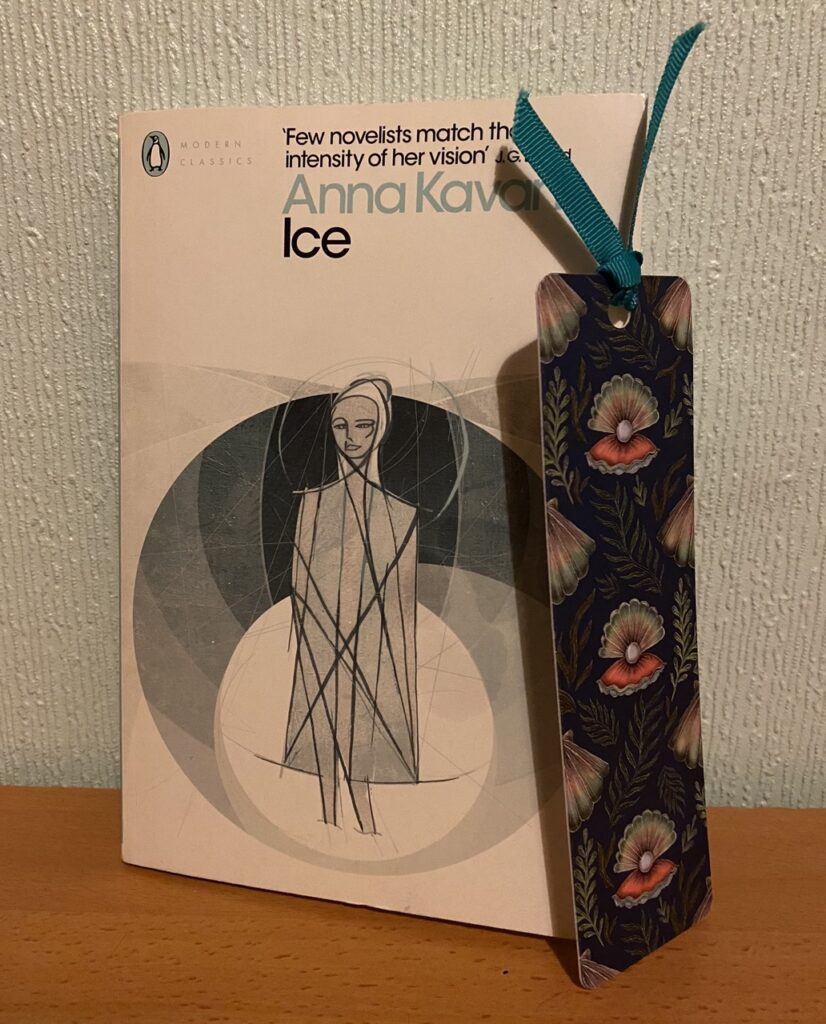
Ice, Anna Kavan, Penguin Modern Classics 2017.

Written in 1967 during the emergence of genre fiction such as science fiction, Anna Kavan’s Ice weaves a world of political turmoil and climate catastrophe on the brink of “a mysterious impending emergency”. The reader traverses this domain through the unreliable narration of a man hellbent on tracking down the nameless girl to “shield her from the callousness” of Kavan’s twisted freezing world. Instantly worrying from the start, the narrator’s obsession with the girl grows throughout the text as he repeatedly comes close to her before being forced to forgo his progress by the changing climate, both political and natural, of the world around them. Joining the narrator and the girl in the novel’s main narrative is the Warden, a character that feels an ownership of the girl mirroring the plight of the narrator. Between the two male characters, Kavan creates a cross-section of what today one would term ‘toxic masculinity, apparent in their behaviors not only toward the girl but also toward each other.

“I was totally absorbed in that obsessional need, as for a lost, essential portion of my own being. Everything else in the world seemed immaterial.”

Kavan, 2017, pg. 25.

While the content of the novel can come as a shock to the reader given the morbid and harmful narrative surrounding the characters of Ice, there is certainly plenty of joy to be felt regarding Kavan’s writing itself. Diving in and out of glorious dream sequences, Kavan’s descriptions of the world around the characters are equivocal of the world-building of a great fantasy epic, or the symbolism in late 19th century French poetry and later Anglophone Modernism. A passage that particularly draws attention to the wonder of Kavan’s writing, while simultaneously intertwining the text’s narrative with the overarching ecological themes of the novel, comes at the beginning of the fifth chapter: 

“Fear was the climate she lived in; if she had ever known kindness it would have been different. The trees seemed to obstruct her with deliberate malice. All her life she had thought of herself as a foredoomed victim, and now the forest had become the malign force that would destroy her.”

Kavan, 2017, pg. 54.

Kavan’s personification of the forest surrounding the girl in this passage captures the impending terror of the claim the men of the text feel towards her, while presenting through nature to evoke the fear of the climate crisis that the novel also explores. 

            Another aspect of this selected passage is the suggestion that the girl’s life may have been different had she known “kindness”. Confronted with this, the reader can take a psychoanalytical approach to Ice, given theories based on Freudian ideologies that link trauma faced back to childhood. Having been subjected to a childhood alongside a “sadistic mother”, the narrator claims this has left the girl in a state of permanent “frightened subjection”.  Kavan herself faced an upsetting upbringing, therefore it’s hard to imagine that the trauma of the girl is not in some part autobiographical. The Girl herself proves to be a complex character, however, breaking free of the bonds of psychoanalytical theory by being able to find temporary happiness later in the novel. In doing this Kavan does not limit her only female character to being the plaything of the Narrator and the Warden, although her role as their object of desire does define her place in the text. 

“When I considered that imperative need I felt for her, as for a missing part of myself, it appeared less like love than an inexplicable aberration.”

Kavan, 2017, pg. 23.

            The climate catastrophe that creeps its way ever closer to the characters throughout the text can be linked to the mental state of the Narrator throughout the text, further entwining a psychoanalytical theme throughout the text. The Narrator himself admits this connection to the reader, as he states, “it was bitterly cold, and I became aware of a connexion between this fact and my increasing uneasiness”. The Narrators need and desperation for the Girl grows throughout the novel as the doom of the ice grows closer. One could interpret this as an allusion to the growing fears of nuclear war during the sixties, as Russia and the US seemed to be on an atomic bomb fuelled collision course. 

“The government would not disclose the facts. I was informed privately of a steep rise in radioactive pollution pointing to the explosion of a nuclear device”

Kavan, 2017, pg. 21.

            Kavan’s novel stands as an outstanding piece of literature that is deservedly returning to the literary canon for works written/set in the post-war period, following a republication by Penguin in 2017. For me personally, her writing offset the morbidity of the text’s main plot fantastically well, as it is admittedly a hard read and one that should be accompanied by cups of tea a plenty, and comfort biscuits abound. It is a book that I look forward to returning to in the future, and would happily recommend it to anyone interested in the origins of genre fiction, especially from the often-overlooked female authors of this period. 

Drive Your Plow Over the Bones of the Dead

Tokarczuk’s novel Drive Your Plow over the Bones of the Dead, translated wonderfully by Antonia Lloyd Jones, is a beautifully crafted journey that encapsulates the pain of emotion that the best humans find in a deep love of nature. Centred around poaching and hunting in a wonderfully vivid and immersive Polish plateau, Tokarczuk confronts the reader with questions of justice and morality through an ecocritical lens. Tokarczuk perfectly captures the love that all pet owners or nature lovers should feel through protagonist Duszejko. Filled with Blake, astrology, and romantic imagery, this is an exceptional novel that I would wholeheartedly recommend to all bookworms.

Powered by WordPress & Theme by Anders Norén

This website was created using Coventry.Domains, a service of the Coventry University Group. The information, views, opinions and discussion contained on this website are those of the author(s) and do not necessarily reflect the views and opinions of the Coventry University Group. For more information on privacy, cookies, takedown requests and more, visit our policies page.