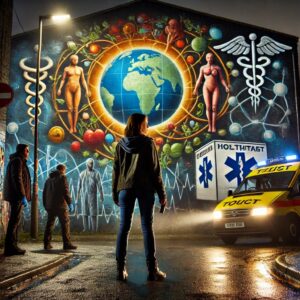
The biting Hertfordshire wind whipped at Sarah’s face as she trudged down the dimly lit alleyway. Her phone’s flashlight beam danced nervously, illuminating graffiti-covered walls and overflowing bins. This wasn’t her usual Tuesday. She was a Community Outreach Support Worker with the Hertfordshire Partnership NHS Foundation Trust, and her usual Tuesdays involved home visits, connecting vulnerable individuals with mental health services, and gentle encouragement. Tonight, however, was different. Tonight, she was following a lead.
Earlier that day, a frantic call had come in from a local soup kitchen. A young man, known only as ‘Sparks’, had been ranting about voices and claiming someone was trying to hurt him. He’d vanished before staff could get him proper help, muttering about “the mural” and “they’ll see.” The soup kitchen volunteers knew Sarah – her reputation for quiet persistence preceded her – and begged her to try and find him.
The “mural” turned out to be a large, community-painted artwork tucked away in this neglected corner of Hemel Hempstead. Sarah had seen it before; a vibrant explosion of colours depicting interconnectedness and global health. It was a project supported by a Global Healthcare Management initiative, a fact that seemed strangely at odds with the grime and desperation surrounding it.
As she reached the mural, a figure emerged from the shadows. It was Sparks, hunched and agitated, his eyes wide with fear. He clutched a can of spray paint. “They’re watching me,” he whispered, his voice trembling. “They know I know.”
Suddenly, a car engine roared to life at the end of the alley. Headlights cut through the darkness, revealing two men in dark jackets. They weren’t the police. Sarah felt a prickle of fear. This wasn’t just a mental health crisis; something else was going on.
“Sparks, we need to go,” Sarah said, keeping her voice calm. She knew she couldn’t outrun them, but she could try to de-escalate. She stepped between Sparks and the approaching car. “These men are here to help you,” she lied, hoping to buy some time.
One of the men sneered. “Get out of the way, social worker. This doesn’t concern you.”
Sarah stood her ground. “It concerns anyone who cares about this community. What do you want with him?”
The men exchanged a look. “He saw something he shouldn’t have,” one of them growled. “Something about… the shipment.”
“Shipment?” Sarah’s mind raced. The mural… Global Healthcare Management… Could there be a connection?
Sparks, seeing his chance, darted behind Sarah and pointed at a section of the mural. “It’s there! Hidden! They’re smuggling something!”
Before Sarah could react, one of the men lunged forward, trying to grab Sparks. Sarah shoved him back, her adrenaline surging. She wasn’t trained for this, but she wouldn’t let them take him.
Just then, sirens wailed in the distance. The men hesitated, then jumped back into their car and sped away.
Sarah breathed a sigh of relief. The police would be here soon. She turned to Sparks, who was shaking uncontrollably. “It’s okay now,” she said gently. “You’re safe.”
As the police investigated, Sarah sat with Sparks, listening to his fragmented story. He’d seen the men hiding something behind the mural, something that looked like medical supplies, but he suspected it wasn’t legitimate.
The next day, the police uncovered a hidden compartment behind the mural containing illegal pharmaceuticals. The connection to Global Healthcare Management was still being investigated, but it was clear that something was deeply wrong.
Sarah’s Tuesday had taken a dangerous turn, but it had also highlighted the importance of her work. She wasn’t just a support worker; she was a vital link in the community, a protector of the vulnerable, and sometimes, even a shield against the darkness. As she looked at the vibrant mural, now a symbol of something more sinister, she knew her work was far from over. The fight for the well-being of her community, both physical and mental, had just begun.
Leave a Reply