
What are the chances of Genetic Variations in Serotonin Transporter Gene (SLC6A4) and Depression Risk Across Ethnicities: You will be amazed if you Examine how genetic variations in the serotonin transporter gene affect depression risk differently across various races and ethnic groups?
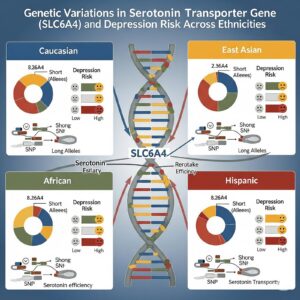
The relationship between genetic variations in the serotonin transporter gene (SLC6A4), particularly the 5-HTTLPR polymorphism, and the risk of depression is a complex area of research with findings that vary across different ethnic groups.
Here’s a breakdown of what the science says:
The 5-HTTLPR Polymorphism: The SLC6A4 gene has a region called the promoter, which acts like a switch to turn the gene on or off. Within this promoter is a polymorphism known as 5-HTTLPR, which commonly comes in two forms: a “short” (S) allele and a “long” (L) allele.
The short (S) allele is generally associated with lower transcriptional efficiency, meaning it produces less of the serotonin transporter protein. This can lead to higher levels of serotonin in the synapse, as there are fewer transporters to reabsorb it.
The long (L) allele is associated with higher transcriptional efficiency and more serotonin transporter protein.
Gene-Environment Interaction: A key finding is that the 5-HTTLPR polymorphism often interacts with stressful life events to influence depression risk. Individuals with the short allele may be more susceptible to developing depression following significant stress or trauma compared to those with two long alleles. However, without stressful life events, the genotype may not have a significant effect on depression probability.
Ethnic and Racial Differences: The frequency of the S and L alleles of 5-HTTLPR varies significantly across different populations. This variation can partly explain why the association between this polymorphism and depression is not consistent across all ethnic groups.
East Asian Populations: Studies have suggested a strong association between polymorphisms in SLC6A4 and a higher risk for major depression and suicidal tendencies in people of East Asian ancestry. It’s been proposed that the SLC6A4 gene has undergone strong positive selection in these populations.
European Populations: In individuals of European descent, the L allele of 5-HTTLPR has been associated with a better response to antidepressant medications, particularly selective serotonin reuptake inhibitors (SSRIs). Conversely, carriers of the short allele may experience more adverse drug reactions. The association between 5-HTTLPR and depression itself in European populations has yielded inconsistent results in some studies.
African Populations: There is a clear clustering of genetic variations in SLC6A4 that distinguishes African populations from others. More research is needed to fully understand the specific implications of these variations for depression risk in these groups.
Other Genetic Factors: It’s important to remember that depression is a complex, polygenic disorder. This means it is influenced by many genes, not just SLC6A4. Other polymorphisms and genes, as well as epigenetic factors like DNA methylation, also play a role in the development of depression.
In conclusion, while the serotonin transporter gene is a significant area of interest in depression research, its influence is not straightforward. The risk of developing depression is a result of a complex interplay between an individual’s genetic makeup, including variations in genes like SLC6A4, and their life experiences. The notable differences in the frequency of these genetic variations across ethnicities highlight the importance of considering ancestry in psychiatric genetics understanding.
Check the link for more on ResearchGate;
Leave a Reply