Faculty of Arts and Humanities
School of Art and Design

Academic Year: 2021-22
Project Leaders: Dr John Hammersley, Terrence Chong
Partner University(s)/Organisation(s): Raffles Design Institute (Singapore)
Project Overview:
This COIL project enabled students on the MA Graphic Design course at Coventry to collaborate with students on BA Graphic Design at Raffles Design Institute, Singapore to investigate experimental approaches to exploring the cultural particulars of design grammar and vocabulary in the built landscape of Coventry and Singapore.
While design vocabulary is often proposed to be universal, its application in different contexts responds to and expresses particularities of the socio-cultural context.
Three main approaches to experimentation were explored; the animation of basic design elements to communicate spatio-temporal relationships in design visualisations, the integration of contrasting typographic compositional systems into interactive formats that activate the tensions between type as image and text, and the scaling of mapping patterns and projection back into the context of the built landscape as a means of re-contextualising abstracted graphic communication.
The students worked in collaborative teams to research the cultural, architectural and design contexts of their partner cities and fed back to research partners informing their conceptual approaches to research material generation and experimentation. This mirroring method responds to the belief that in dialogue interlocutors are also ‘interlocators’ and potentially able to picture back to us our cultural horizons in a manner that may reveal our blind spots. The project developed a relay method for the generation of primary visual material, with Singapore students collecting material about Singapore for Coventry students to experiment with and vice-versa. This process emphasised the importance of reliability and developing co-responsibility in collaborative international design projects that have both asynchronous and synchronous processes.
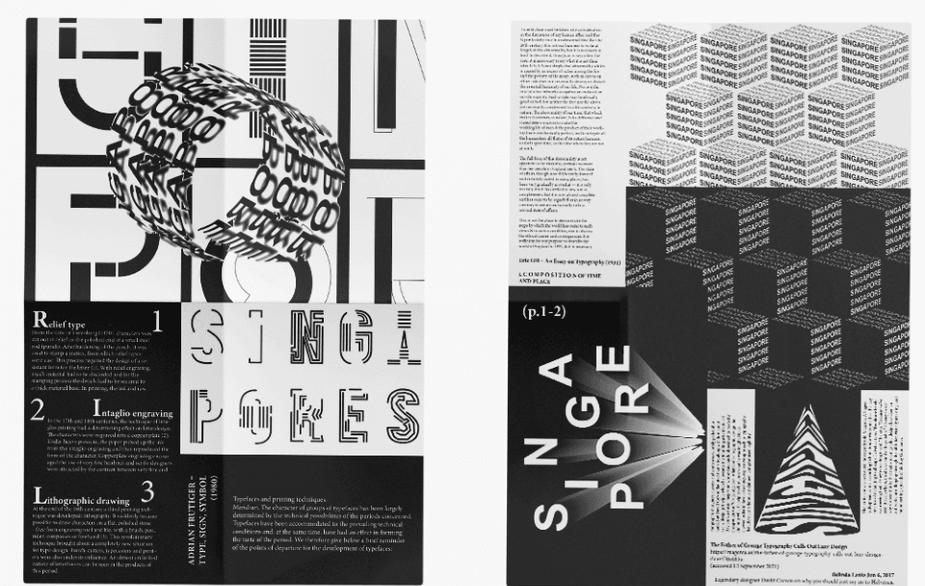
Students were invited to select one outcome from the experimental stage for inclusion in an online exhibition, which was constructed, curated and branded by students.
Students commented that they enjoyed exploring the culture of a city other than their own through design experimentation, and found the material generation tasks were essential to them as designers as they helped them to develop a better eye for design vocabulary and their surroundings.
Online Tools Used: Open Moodle, Artsteps, Padlet, Instagram, Facebook
Artsteps exhibition
https://www.facebook.com/CreativeHothausInternational
Leave a Reply
You must be logged in to post a comment.