The licences are built using a three-layer design:

  1. The legal code is the “lawyer-readable” terms and conditions legally enforceable in court.
  2. The commons deeds summarize the legal code and consist of web pages that lay out the key licence terms in “human-readable” format.
  3. The machine-readable version makes it easy for websites and web services to know when a work is available under a CC licence – a recognition that software plays a critical role in creating, copying, discovering, and distributing works.
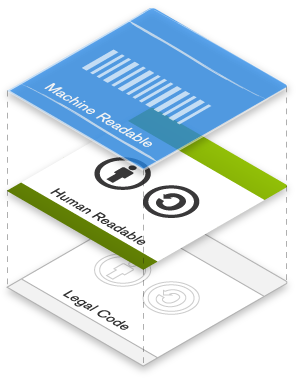
Three layers are stacked vertically and slightly separated to show their sections clearly. They represent visually the Creative Commons licences, where each layer is labelled and visually distinct: the top layer, labelled "Machine Readable” and featuring a barcode, indicates the layer designed for straightforward interpretation by computers and software; the middle layer, labelled "Human Readable" and showing two icons (A graphic of a man inside a circle next to a C-shaped arrow pointing counter-clockwise inside a second circle), signifies that this part of the license is written in a way that is easily understandable by people; and a bottom layer, labelled "Legal Code" with a faded appearance and including the same markets as the latter, represents the formal, legal text of the license, providing the detailed legal framework.
Three layers of the licence sit on top of each other. Layers © Creative Commons. Licensed under a CC BY 4.0 licence

Forward to How do you reference and acknowledge Creative Commons licensed works?

Back to What are the six Creative Commons licences?

Back to Creative Commons licences

Back to Open licences

Back Home

The author takes no responsibility for the content of this page, which is not intended as binding legal advice. The views are about copyright in the UK Higher Education sector context.