The author takes no responsibility for the content of this page, which is not intended as binding legal advice. The views are about copyright in the UK Higher Education sector context.
Licences allow copyright owners to permit others to use the owned work. They can be exclusive, non-exclusive and open.
Licences should not be confused with the assignment of rights, where the copyright ownership is transferred from one entity to another.
The reuse of material has to fall within the terms allowed by the licence chosen by the copyright holder, apart from the following scenarios:
As a user, you can justify the application of one of the copyright exceptions or
The material is in the public domain and, hence, not subject to any licences.
Licenced material may be purchased through paid agreements (for example, through an institutional licence or contracts) or accessed for free if released to the public with an open licence or following an ad hoc permission granted by the copyright holder.
The author takes no responsibility for the content of this page, which is not intended as binding legal advice. The views are about copyright in the UK Higher Education sector context.
Free Art Licence grants the right to freely copy, distribute, and transform creative works without any changes. It needs to be acknowledged in the following way:
[author], “[title]”, [date of the work]. [where to find the originals]. Copyleft: This is a free work. You can copy, distribute, and modify it under the terms of the Free Art License http://artlibre.org/licence/lal/en/
The author takes no responsibility for the content of this page, which is not intended as binding legal advice. The views are about copyright in the UK Higher Education sector context.
If the Information Provider does not provide a specific attribution statement, you must use the following:
Contains public sector information licensed under the Open Government Licence v3.0
If you are using information from several information providers and listing multiple attributions is not practical for your product or application, you may include a URI or hyperlink to a resource that contains the required attribution statements.
The author takes no responsibility for the content of this page, which is not intended as binding legal advice. The views are about copyright in the UK Higher Education sector context.
A free or open licence is a licensing agreement that allows individuals to reuse another creator’s work. This use is granted by the copyright owner at the start.
The author takes no responsibility for the content of this page, which is not intended as binding legal advice. The views are about copyright in the UK Higher Education sector context.
The author takes no responsibility for the content of this page, which is not intended as binding legal advice. The views are about copyright in the UK Higher Education sector context.
The author takes no responsibility for the content of this page, which is not intended as binding legal advice. The views are about copyright in the UK Higher Education sector context.
Wikimedia and Wikipedia’s material minimum standard licence is the Creative Commons By Attribution ShareAlike.
You will be able to find material labelled with the Creative Commons By Attribution and the public domain.
Please note that Wikimedia and Wikipedia’s material are distributed under the US copyright law. Use care in selecting items licensed in the public domain are not necessarily so in the UK or other countries. It is advisable to follow the link to the original source and seek released and licence information from it rather than rely on what is displayed on Wikipedia/Wikimedia.
Assuming that the work is correctly licensed from Wikimedia, you may click on the world icon to discover the following:
The author takes no responsibility for the content of this page, which is not intended as binding legal advice. The views are about copyright in the UK Higher Education sector context.
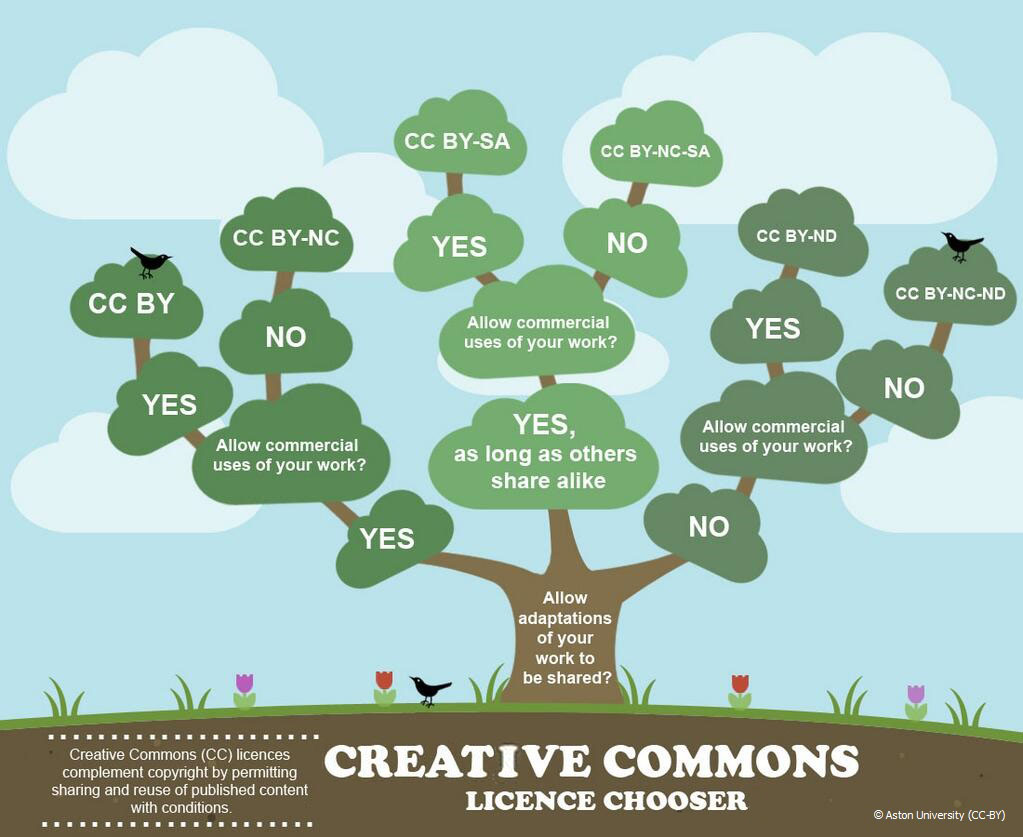
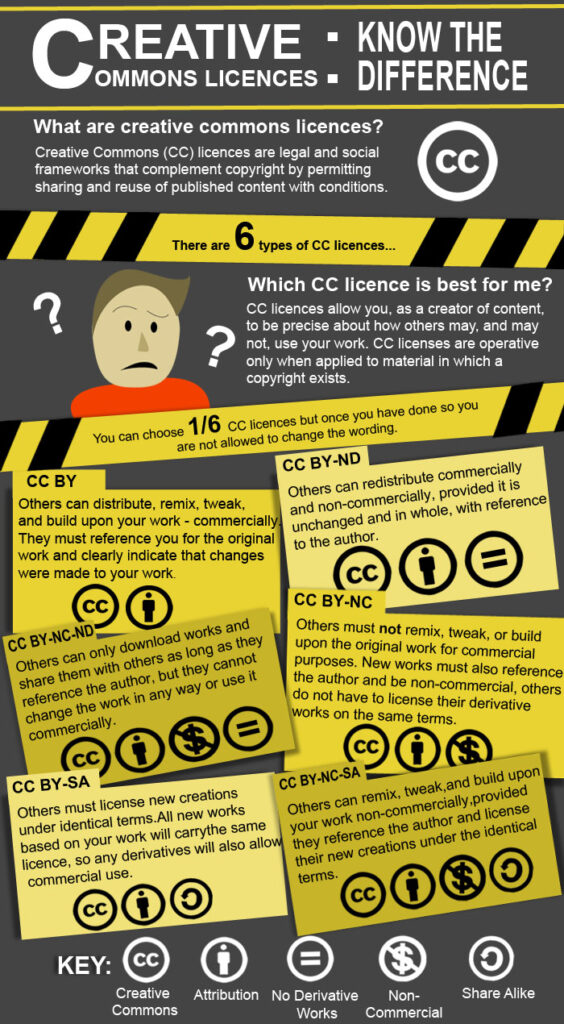
Attribution lets others distribute, remix, tweak and build upon the work, even commercially, as long as it is credited to the original owner.
BY – Credit must be given to the creator
CC BY NC
Attribution-NonCommercial lets others remix, tweak, and build upon the work non-commercially. Although the new works must acknowledge the original owner and be non-commercial, they don’t have to license their derivative works on the same terms.
BY – Credit must be given to the creator NC – Only noncommercial uses of the work are permitted
BY SA
Attribution-ShareAlike lets others remix, tweak, and build upon the work, even for commercial purposes, as long as the original copyright owner is credited and the new creation is licensed under identical terms. All new works will carry the same licence so that any derivatives will allow commercial use.
BY – Credit must be given to the creator SA – Adaptations must be shared under the same terms
BY ND
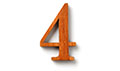
Attribution-NoDerivs allows for commercial and non-commercial redistribution as long as it is passed along unchanged and in whole, with credit to the original copyright owner.
BY – Credit must be given to the creator ND – No derivatives or adaptations of the work are permitted
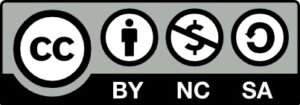
BY NC SA
Attribution-NonCommercial-ShareAlike lets others remix, tweak, and build upon the work non-commercially, as long as the original owner is credited and the licence of the new creation is under identical terms.
BY – Credit must be given to the creator NC – Only non-commercial uses of the work are permitted SA – Adaptations must be shared under the same terms
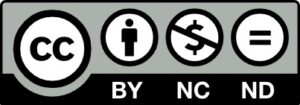
CC BY NC ND
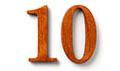
Attribution-NonCommercial-NoDerivs is the most restrictive of the six licences, allowing others to download and share work, as long as they credit it to the original copyright owner; however, works cannot be changed in any way or used commercially.
BY – Credit must be given to the creator NC – Only non-commercial uses of the work are permitted No derivatives or adaptations of the work are permitted
In addition, CC also has two public domain tools, though they are not licences.
The author takes no responsibility for the content of this page, which is not intended as binding legal advice. The views are about copyright in the UK Higher Education sector context.
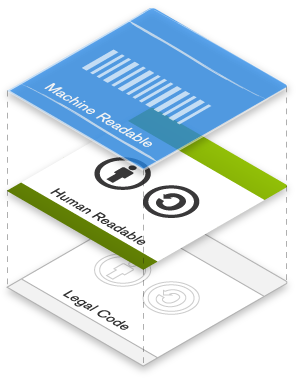
The licences are built using a three-layer design:
The legal code is the “lawyer-readable” terms and conditions legally enforceable in court.
The commons deeds summarize the legal code and consist of web pages that lay out the key licence terms in “human-readable” format.
The machine-readable version makes it easy for websites and web services to know when a work is available under a CC licence – a recognition that software plays a critical role in creating, copying, discovering, and distributing works.
The author takes no responsibility for the content of this page, which is not intended as binding legal advice. The views are about copyright in the UK Higher Education sector context.
Manage Cookie Consent
We use cookies to optimise our website and our service.
Functional
Always active
The technical storage or access is strictly necessary for the legitimate purpose of enabling the use of a specific service explicitly requested by the subscriber or user, or for the sole purpose of carrying out the transmission of a communication over an electronic communications network.
Preferences
The technical storage or access is necessary for the legitimate purpose of storing preferences that are not requested by the subscriber or user.
Statistics
The technical storage or access that is used exclusively for statistical purposes.The technical storage or access that is used exclusively for anonymous statistical purposes. Without a subpoena, voluntary compliance on the part of your Internet Service Provider, or additional records from a third party, information stored or retrieved for this purpose alone cannot usually be used to identify you.
Marketing
The technical storage or access is required to create user profiles to send advertising, or to track the user on a website or across several websites for similar marketing purposes.
This website was created using Coventry.Domains, a service of the Coventry University Group. The information, views, opinions and discussion contained on this website are those of the author(s) and do not necessarily reflect the views and opinions of the Coventry University Group. For more information on privacy, cookies, takedown requests and more, visit our policies page.
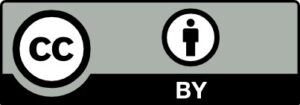
 BY – Credit must be given to the creator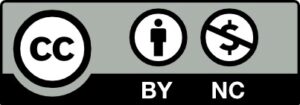
 NC – Only noncommercial uses of the work are permitted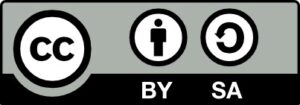
 SA – Adaptations must be shared under the same terms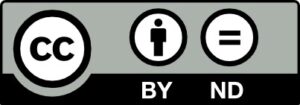
 ND – No derivatives or adaptations of the work are permitted