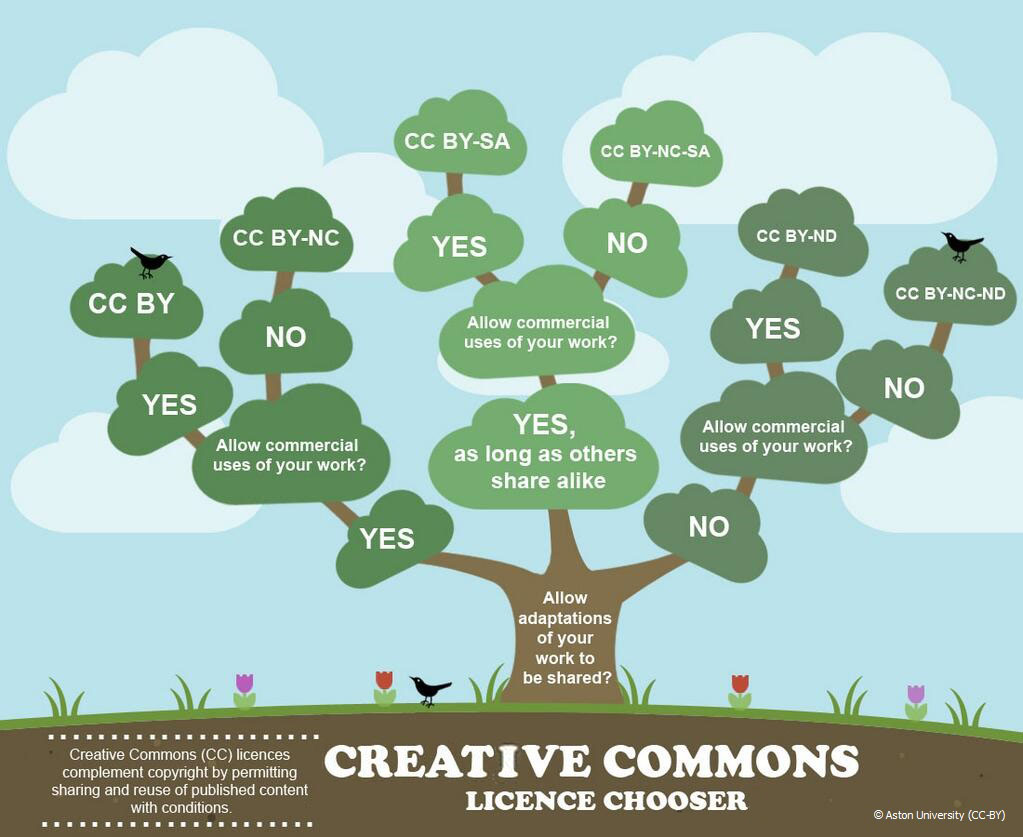
The colourful infographic from Aston University (licensed CC-BY) is a tree diagram explaining how creators can choose different Creative Commons licenses. It presents green leaves on the tree branches, a blue sky with clouds in the background, and a grassy ground with flowers. The overall design is friendly and visually appealing, making the information accessible and easy to understand. The image is titled "Creative Commons Licence Chooser” and briefly explains Creative Commons licences. It reads: "Creative Commons (CC) licences complement copyright by permitting sharing and reuse of published content with conditions." The Tree Diagram Structure has multiple branches, each representing a different Creative Commons licence. The branches split on whether the licence will allow commercial use and whether adaptations of the work are permitted. Each branch has green leaves with text indicating the licence type and answers to specific questions about the licence conditions. Starting from the trunk, the first question is, “Allow adaptations of your work to be shared?”. A positive answer will follow with a further question, “Allow commercial uses of your work?” if the chooser’s answer is positive, then the work will be licensed CC BY (Attribution); if it is negative, the licence will be CC BY-NC (Attribution-NonCommercial). If the answer to the first question, “Allow adaptations of your work to be shared?” was positive if others share alike, a further question will follow again to ascertain whether commercial uses of the work will be allowed: if the chooser’s answer is positive, then the work will be licensed CC BY-SA (Attribution-ShareAlike); if it is negative, the licence will be CC BY-NC-SA (Attribution-NonCommercial-ShareAlike). If the answer to the first question, “Allow adaptations of your work to be shared?” was negative, a further question will follow again to ascertain whether commercial uses of the work will be allowed: if the chooser’s answer is positive, then the work will be licensed CC BY-ND (Attribution-NoDerivs); if it is negative, the licence will be; CC BY-NC-ND (Attribution-NonCommercial-NoDerivs)

Please note that commonly, the Non-Derivative element (ND) of a Creative Commons licence makes the work released NOT with an open licence.

Find here a further infographic, also from Aston University:
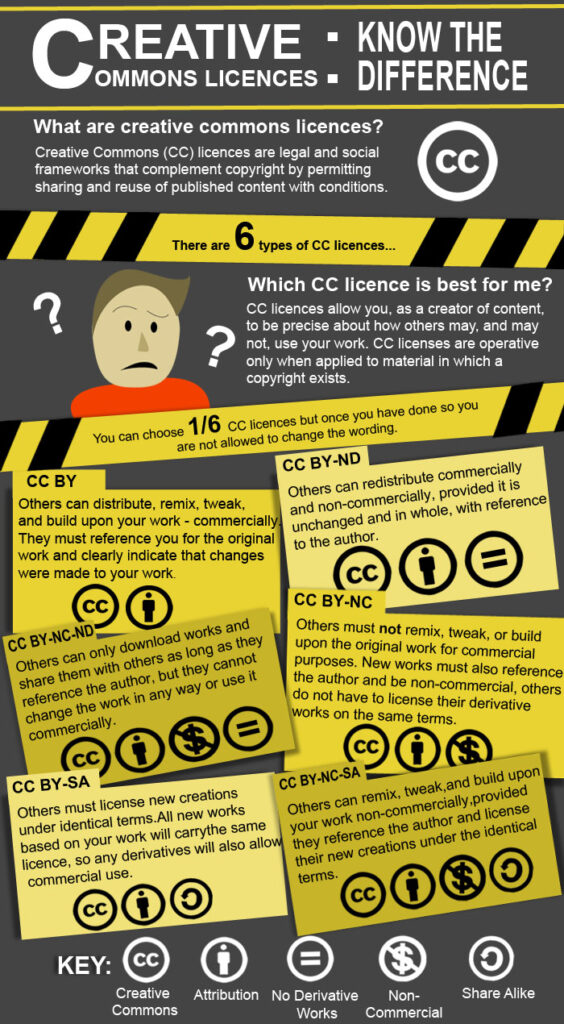
The image is an infographic titled "Creative Commons Licences - Know the Difference". It explains Creative Commons (CC) licences, which allow content creators to specify how others can use their work. There are six types of CC licences: CC BY (it allows others to distribute, remix, tweak, and build upon the work, even commercially, as long as credit is given to the original creator); CC BY-SA (others can remix, tweak, and build upon the work even for commercial purposes, as long as they credit the creator and license new creations under identical terms); CC BY-ND (it allows for redistribution, commercial and non-commercial, as long as it is passed along unchanged and with credit to the creator); CC BY-NC (others can remix, tweak, and build upon the work non-commercially, and their new works must acknowledge the creator and be non-commercial; CC BY-NC-SA (others can remix, tweak, and build upon the work non-commercially, as long as they credit the creator and license new creations under identical terms; and CC BY-NC-ND (it allows others to download the works and share them with others as long as they credit the creator, but they can’t change them in any way or use them commercially). The infographic includes icons representing each licence type and conditions, such as Attribution, No Derivative Works, Non-Commercial, and Share Alike.

Forward to Considerations on remixed/adapted and derivative works for Creative Commons licensed material

Back to How do you reference and acknowledge Creative Commons licensed works?

Back to Creative Commons licences

Back to Open licences

Back Home

The author takes no responsibility for the content of this page, which is not intended as binding legal advice. The views are about copyright in the UK Higher Education sector context.