Category: Licences: Open licences: Creative Commons

In this category, you will find posts related to the Creative Commons

Can I apply a CC licence to my work if it incorporates non-CC licensed material?

It depends on the purpose of your publication.

Technically, yes, you may apply one of the Creative Commons licences to your work even if it incorporates material used under fair dealing, which is another exception or limitation to copyright. Still, it is important to prominently mark any third-party material so re-users do not think the Creative Commons licence applies to that material.

The Creative Commons licence only applies to the rights you have in the work. For example, if your Creative Commons licensed slide deck includes a Flickr image you are using under any exceptions to copyright law, make sure to identify that image as not subject to the Creative Commons licence. For more information about incorporating work owned by others, see our page about marking third-party content.

Suppose you publish a new creation, for example, an Open Access journal article. In that case, it is better to seek permission from the copyright holder, making it clear that you will apply an open licence to the whole work. Whilst they’ll indicate to readers that their copyrighted resource is excluded from this licence, you cannot control downstream use. Unfortunately, it may increase the chance that the third-party copyright owner will reject the request, compared to a request for a ‘paywalled’ publication where distribution is more limited.

Extract from the Creative Commons’ Frequently Asked Questions webpage. It is available from https://creativecommons.org/faq/#may-i-apply-a-cc-license-to-my-work-if-it-incorporates-material-used-under-fair-use-or-another-exception-or-limitation-to-copyright [accessed on 2 February 2022]

The author takes no responsibility for the content of this page, which is not intended as binding legal advice. The views are about copyright in the UK Higher Education sector context.
How do I pick a Creative Commons licence for my work?

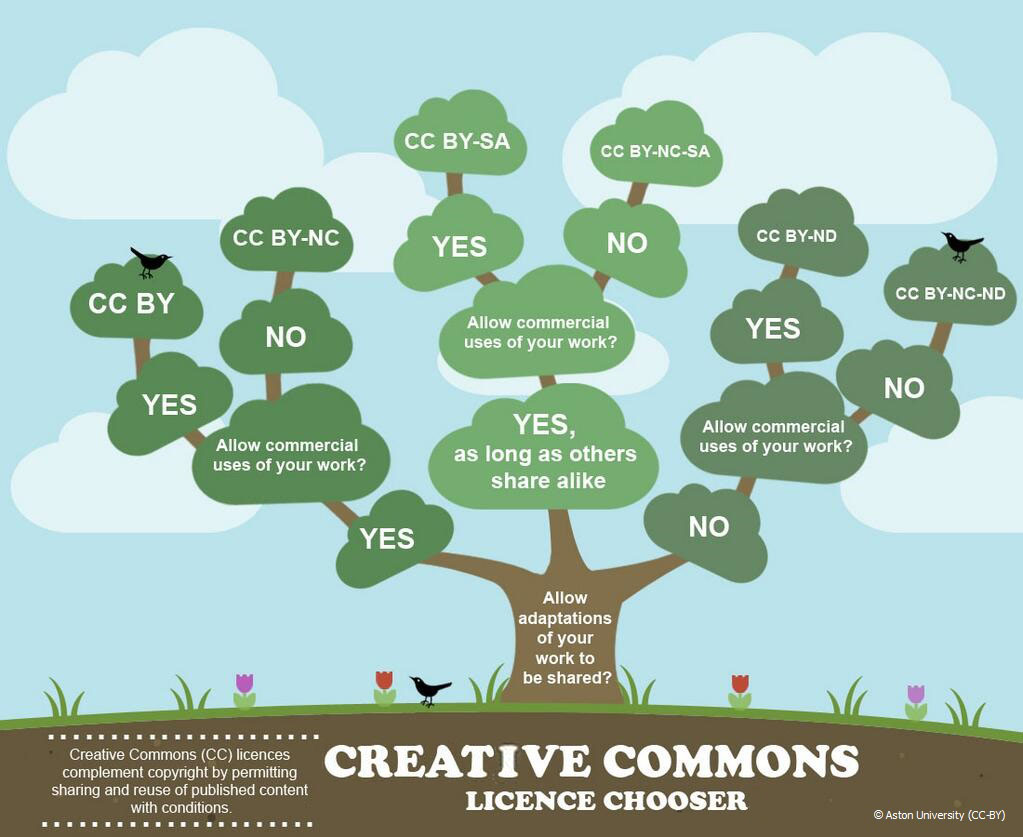
The colourful infographic from Aston University (licensed CC-BY) is a tree diagram explaining how creators can choose different Creative Commons licenses. It presents green leaves on the tree branches, a blue sky with clouds in the background, and a grassy ground with flowers. The overall design is friendly and visually appealing, making the information accessible and easy to understand. The image is titled "Creative Commons Licence Chooser” and briefly explains Creative Commons licences. It reads: "Creative Commons (CC) licences complement copyright by permitting sharing and reuse of published content with conditions." The Tree Diagram Structure has multiple branches, each representing a different Creative Commons licence. The branches split on whether the licence will allow commercial use and whether adaptations of the work are permitted. Each branch has green leaves with text indicating the licence type and answers to specific questions about the licence conditions. Starting from the trunk, the first question is, “Allow adaptations of your work to be shared?”. A positive answer will follow with a further question, “Allow commercial uses of your work?” if the chooser’s answer is positive, then the work will be licensed CC BY (Attribution); if it is negative, the licence will be CC BY-NC (Attribution-NonCommercial). If the answer to the first question, “Allow adaptations of your work to be shared?” was positive if others share alike, a further question will follow again to ascertain whether commercial uses of the work will be allowed: if the chooser’s answer is positive, then the work will be licensed CC BY-SA (Attribution-ShareAlike); if it is negative, the licence will be CC BY-NC-SA (Attribution-NonCommercial-ShareAlike). If the answer to the first question, “Allow adaptations of your work to be shared?” was negative, a further question will follow again to ascertain whether commercial uses of the work will be allowed: if the chooser’s answer is positive, then the work will be licensed CC BY-ND (Attribution-NoDerivs); if it is negative, the licence will be; CC BY-NC-ND (Attribution-NonCommercial-NoDerivs)

Please note that commonly, the Non-Derivative element (ND) of a Creative Commons licence makes the work released NOT with an open licence.

Find here a further infographic, also from Aston University:

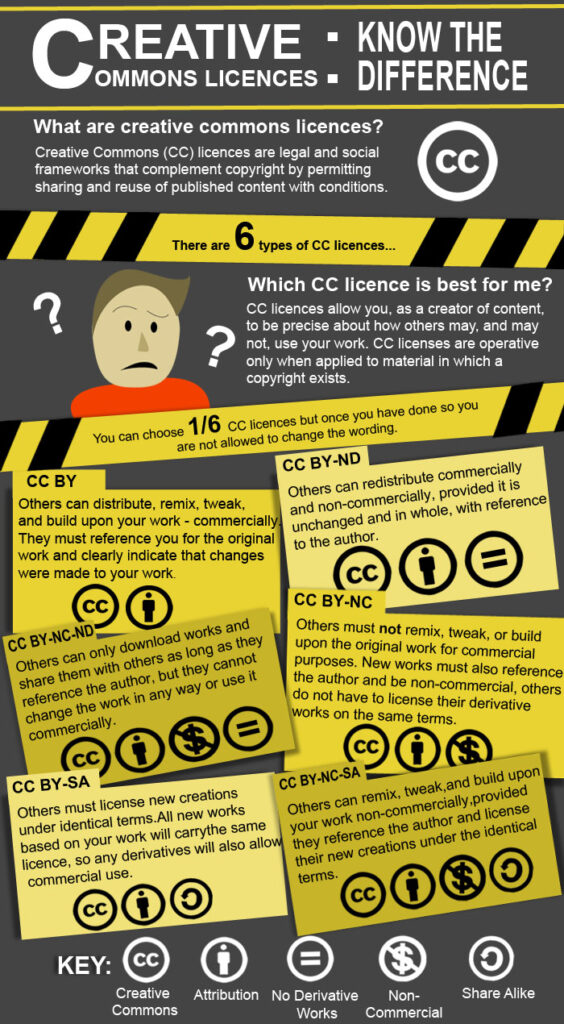
The image is an infographic titled "Creative Commons Licences - Know the Difference". It explains Creative Commons (CC) licences, which allow content creators to specify how others can use their work. There are six types of CC licences: CC BY (it allows others to distribute, remix, tweak, and build upon the work, even commercially, as long as credit is given to the original creator); CC BY-SA (others can remix, tweak, and build upon the work even for commercial purposes, as long as they credit the creator and license new creations under identical terms); CC BY-ND (it allows for redistribution, commercial and non-commercial, as long as it is passed along unchanged and with credit to the creator); CC BY-NC (others can remix, tweak, and build upon the work non-commercially, and their new works must acknowledge the creator and be non-commercial; CC BY-NC-SA (others can remix, tweak, and build upon the work non-commercially, as long as they credit the creator and license new creations under identical terms; and CC BY-NC-ND (it allows others to download the works and share them with others as long as they credit the creator, but they can’t change them in any way or use them commercially). The infographic includes icons representing each licence type and conditions, such as Attribution, No Derivative Works, Non-Commercial, and Share Alike.

Forward to Considerations on remixed/adapted and derivative works for Creative Commons licensed material

Back to How do you reference and acknowledge Creative Commons licensed works?

Back to Creative Commons licences

Back to Open licences

Back Home

The author takes no responsibility for the content of this page, which is not intended as binding legal advice. The views are about copyright in the UK Higher Education sector context.
Creative Commons licences

Find here at a glance information on the Creative Commons:

1. What are the Creative Commons licences?
2. Fair dealing and the reuse of Creative Commons licensed works
3. What are the elements of the Creative Commons?
4. What are the six Creative Commons licences?
5. How do the Creative Commons licences work technically?
6. How do you reference and acknowledge Creative Commons licensed works?
7. How do I pick a Creative Commons licence for my work?
8. Considerations on remixed/adapted and derivative works for Creative Commons licensed material
9. Creative Commons’ adapters and remixers licence chart
10. How can I use works on Wikimedia and Wikipedia?

See also:

What are Open Educational Resources?

What is Open Access in scholarship?


Back to Open licences

Back to Licences

Back Home

The author takes no responsibility for the content of this page, which is not intended as binding legal advice. The views are about copyright in the UK Higher Education sector context.
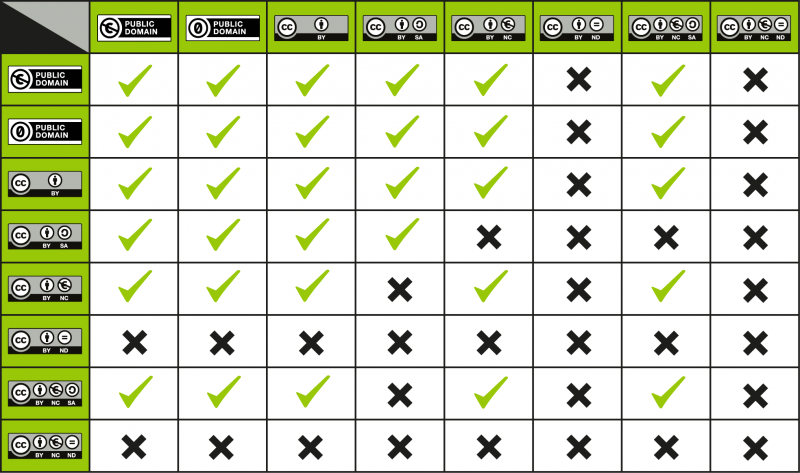
Creative Commons adapters and remixers licence chart

The following chart from the Creative Commons is a guide to ensure that adaptations comply with the licences’ terms.

The left-hand column identifies the licence of the original work to use in the adaptation.

By looking across the table, it shows the available licences for the new creation.

The table is titled "Adapter's licence chart" and details the compatibility of different licences for adapting works based on their original licence. It helps determine which licences are compatible for adapting works, ensuring proper usage and adherence to licensing terms. The table is organised with the "Status of original work" listed in the leftmost column and the "Adapter's licence" types listed across the top row. The intersections of these rows and columns are colour-coded to indicate compatibility: green cells represent permissible combinations, yellow cells represent permissible combinations with some restrictions, and grey cells represent combinations that are not allowed. Colour-coded details: for Public Domain as original work, all adapter licences are green; for  By Attribution as original work, it is green for BY, BY-NC, BY-NC-ND, BY-NC-SA, BY-SA, BY-ND and yellow for PD; for  By Attribution NonCommercial as original work, it is green for BY-NC, BY-NC-ND, BY-NC-SA and yellow for BY-NC, BY-ND, BY-SA, PD; for  By Attribution NonCommercial-NoDerivs as original work, it is grey for all adapter licences; for  By Attribution NonCommercial-ShareAlike as original work, it is green for BY-NC-SA only and grey for all other adapter licences; for By Attribution NoDerivs as original work, it is grey for all adapter licences; for By Attribution ShareAlike as original work, it is green for BY-SA only and grey is grey for all adapter licences.

CC does not recommend using a licence if the corresponding box is yellow, although doing so is technically permitted by the licence terms.
The grey boxes indicate those licences that one may not use as an adapter’s licence.

Examples:

  • If one adapts a BY-NC work, the BY-NC will do for the adaptation.
  • If one adapts a BY work, either BY or BY-NC will do for the adaptation.
  • Work licensed with BY-SA or BY-NC-SA must have the same licence applied for the adaptation.

Another type of licence compatibility relates to licences when remixing more than one pre-existing work.

The chart helps users understand which Creative Commons licenses can be used together when mixing or reusing content under different licensing terms. The leftmost column lists different types of Creative Commons licenses, and the top row lists the same licenses. The intersections of these rows and columns indicate whether a specific combination of licenses is compatible, where each cell in the grid either has a checkmark (signifying that the combination of licenses is compatible) or a black "X (indicating that the combination of licenses is incompatible). In particular, Public Domain and CC BY (Attribution) are compatible with all but those with a NoDerivs element; CC BY-SA (Attribution-ShareAlike) is compatible with all but those with NonCommercial and NoDerivs elements; CC BY-NC (Attribution-NonCommercial) and CC BY-NC-SA (Attribution-NonCommercial-ShareAlike) are compatible with all but CC BY-SA (Attribution-ShareAlike) and those with a NoDerivs element; CC BY-ND Attribution-NoDerivs and CC BY-NC-ND Attribution-NonCommercial-NoDerivs are incompatible with any.

Find on the left column a licence of the works and match it with the one on the top to discover a licence that may apply to a second work:

  • A ‘tick’ at the intersection means that works under those two licences can be remixed.
  • An ‘X’ usually means the works may not be remixed.

When deciding on a licence to use for the adaptation, it is better to choose the more restrictive of the two licences on the works that are getting combined, to ease reuse for downstream users.


Forward to How can I use works on Wikimedia and Wikipedia?

Back to Considerations on remixed/adapted and derivative works for Creative Commons licensed material

Back to Creative Commons licences

Back to Open licences

Back Home

The author takes no responsibility for the content of this page, which is not intended as binding legal advice. The views are about copyright in the UK Higher Education sector context.

Considerations on remixed/adapted and derivative works for Creative Commons licensed material

An adaptation/remix brings together material from different sources to create a wholly new creation where one often cannot tell where one work ends, and another begins.

An example of an education adaptation would be an open textbook chapter that originates from multiple open educational resources in such a way that readers cannot tell which resource was used on which page without looking at endnotes

  • In all cases, one has to attribute the original work when you create an adaptation. It is important to provide attribution to the individual parts that went into making the adaptation.
  • If the original work was licensed under a NoDerivatives licence 4.0, one can make and use changes privately but cannot share it with others.
  • One has to check licence compatibility to verify which types of licensed works can be adapted into a new work; for example, if the original work was licensed under a ShareAlike licence, one can only license the new work with the same or a compatible licence (see here).

When creating an adaptation of a CC-licensed work, the simplest scenario is when one takes a single CC-licensed work and adapts it.

The more complicated scenario is when one is adapting two or more CC-licensed works into a new work. The Adapter’s Licence has to consider the original licence that will continue to govern the reuse of the elements from the original work.


Forward to Creative Commons’ adapters and remixers licence chart

Back to How do I pick a Creative Commons licence for my work?

Back to Creative Commons licences

Back to Open licences

Back Home

The author takes no responsibility for the content of this page, which is not intended as binding legal advice. The views are about copyright in the UK Higher Education sector context.
Fair dealing and the reuse of Creative Commons licensed works

Unless the person using the work received separate permission or relied on fair dealing or other exceptions to copyright, they are potentially liable for copyright infringement.

If someone uses a CC-licensed work without following the licence, their right to use the work ends automatically as soon as they violate its terms.

Under CC version 4.0, users of CC-licensed works who come into compliance with licence terms within 30 days of discovering they were in violation of the terms have their rights under the licence automatically reinstated.

Sometimes, these types of disputes can end up in court.
Judicial decisions have been made in various places worldwide, and no courts have ever questioned the validity of the CC licence.


Back to Exceptions in copyright

Forward to What are the elements of the Creative Commons?

Back to What are the Creative Commons licences?

Back to Creative Commons licences

Back to Open licences

Back Home

The author takes no responsibility for the content of this page, which is not intended as binding legal advice. The views are about copyright in the UK Higher Education sector context.
What are the six Creative Commons licences?

When combined, the four licence elements form the six CC licences:

A rectangle circumscribing two circles next to each other: one slightly bigger with the letter CC and the second with a graphic of a man.
CC BY

Attribution lets others distribute, remix, tweak and build upon the work, even commercially, as long as it is credited to the original owner.

BY – Credit must be given to the creator


A rectangle circumscribing three circles next to each other: one slightly bigger with the letter CC, the second with a graphic of a man and the third with a line through over a $ sign.
CC BY NC

Attribution-NonCommercial lets others remix, tweak, and build upon the work non-commercially. Although the new works must acknowledge the original owner and be non-commercial, they don’t have to license their derivative works on the same terms.

BY – Credit must be given to the creator
NC – Only noncommercial uses of the work are permitted


A rectangle circumscribing two circles next to each other: one slightly bigger with the letter CC and the second with a C-shaped arrow pointing counter-clockwise.
BY SA

Attribution-ShareAlike lets others remix, tweak, and build upon the work, even for commercial purposes, as long as the original copyright owner is credited and the new creation is licensed under identical terms.
All new works will carry the same licence so that any derivatives will allow commercial use.

BY – Credit must be given to the creator
SA – Adaptations must be shared under the same terms


A rectangle circumscribing three circles next to each other: one slightly bigger with the letter CC, the second with a graphic of a man and the third with an equal “=” sign.
BY ND

Attribution-NoDerivs allows for commercial and non-commercial redistribution as long as it is passed along unchanged and in whole, with credit to the original copyright owner.

BY – Credit must be given to the creator
ND – No derivatives or adaptations of the work are permitted


A rectangle circumscribing four circles next to each other: one slightly bigger with the letter CC, the second with a graphic of a man, the third with a line through over a dollar “$” sign, and the fourth with a C-shaped arrow pointing counter-clockwise.
BY NC SA

Attribution-NonCommercial-ShareAlike lets others remix, tweak, and build upon the work non-commercially, as long as the original owner is credited and the licence of the new creation is under identical terms.

BY – Credit must be given to the creator
NC – Only non-commercial uses of the work are permitted
SA – Adaptations must be shared under the same terms


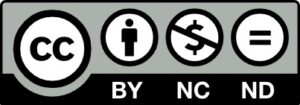
A rectangle circumscribing four circles next to each other: one slightly bigger with the letter CC, the second with a graphic of a man, the third with a line through over a dollar “$” sign, and the fourth a with an equal “=” sign.
CC BY NC ND

Attribution-NonCommercial-NoDerivs is the most restrictive of the six licences, allowing others to download and share work, as long as they credit it to the original copyright owner; however, works cannot be changed in any way or used commercially.

BY – Credit must be given to the creator
NC – Only non-commercial uses of the work are permitted
No derivatives or adaptations of the work are permitted


In addition, CC also has two public domain tools, though they are not licences.


Forward to How do the Creative Commons licences work technically?

Back to What are the elements of the Creative Commons?

Back to Creative Commons licences

Back to Open licences

Back Home

Adapted from “About CC Licenses” © Creative Commons. Licensed under a CC BY 4.0 licence.

The author takes no responsibility for the content of this page, which is not intended as binding legal advice. The views are about copyright in the UK Higher Education sector context.
How do the Creative Commons licences work technically?

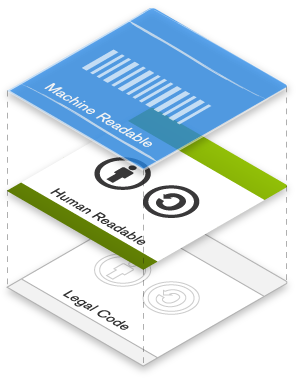
The licences are built using a three-layer design:

  1. The legal code is the “lawyer-readable” terms and conditions legally enforceable in court.
  2. The commons deeds summarize the legal code and consist of web pages that lay out the key licence terms in “human-readable” format.
  3. The machine-readable version makes it easy for websites and web services to know when a work is available under a CC licence – a recognition that software plays a critical role in creating, copying, discovering, and distributing works.
Three layers are stacked vertically and slightly separated to show their sections clearly. They represent visually the Creative Commons licences, where each layer is labelled and visually distinct: the top layer, labelled "Machine Readable” and featuring a barcode, indicates the layer designed for straightforward interpretation by computers and software; the middle layer, labelled "Human Readable" and showing two icons (A graphic of a man inside a circle next to a C-shaped arrow pointing counter-clockwise inside a second circle), signifies that this part of the license is written in a way that is easily understandable by people; and a bottom layer, labelled "Legal Code" with a faded appearance and including the same markets as the latter, represents the formal, legal text of the license, providing the detailed legal framework.
Three layers of the licence sit on top of each other. Layers © Creative Commons. Licensed under a CC BY 4.0 licence

Forward to How do you reference and acknowledge Creative Commons licensed works?

Back to What are the six Creative Commons licences?

Back to Creative Commons licences

Back to Open licences

Back Home

The author takes no responsibility for the content of this page, which is not intended as binding legal advice. The views are about copyright in the UK Higher Education sector context.
What are the elements of the Creative Commons?

The following icons represent the four licence elements:

A graphic of a man inside a circle.

Attribution or “BY” indicates that the original creator needs to be acknowledged.
All of the CC licences include this condition.

A graphic of a circle with a line through it followed by a C-shaped arrow pointing counter-clockwise inside a third circle

ShareAlike or “SA” indicates that adaptations based on this work must be licensed under the same licence.
Two of the CC licences include this condition.

A graphic of a "$" inside a circle with a line through it.

NonCommercial or “NC” means that the work is only available to be used for non-commercial purposes.
Three of the CC licences include this restriction.

A graphic of an "=" inside a circle.

NoDerivatives or “ND” indicates that re-users cannot share work adaptations.
Two of the CC licences include this restriction.


Forward to What are the six Creative Commons licences?

Back to Fair dealing and the reuse of Creative Commons licensed works

Back to Creative Commons licences

Back to Open licences

Back Home

The author takes no responsibility for the content of this page, which is not intended as binding legal advice. The views are about copyright in the UK Higher Education sector context.
What are the Creative Commons licences?

Creative Commons (CC) licences are one of the public copyright licences that enable the free distribution of an otherwise copyrighted creation.

A CC licence is used when an author or copyright owner wants to give other people the right to share, use and build upon a work the author has created.

CC licences are built on copyright and are designed to give more options to creators
who want to share.

Why do we need CC licences?

The CC licences were created in response to an outdated global copyright legal system and to help address the tension between creators’ ability to share digital works globally and copyright regulation.

What is the CC licence scope?

CC licences are appropriate for creators to provide people with permissions governed by copyright from the onset.

  • They warrant that there may be other not covered rights at play with the work that restrict how it is used (i.e., patents, trademarks, privacy and publicity rights) that must be managed separately.

Scenarios in which copyright does not apply and CC licences do not either:

Letting someone specifically read your article or watch your video is not regulated by copyright law.

When fair use, fair dealing or other limitation and exception to copyright applies.

When the work is in the public domain.

How do the Creative Commons licences work technically?

What are the elements of the Creative Commons?

What are the six Creative Commons licences?

How to you reference and acknowledge Creative Commons licensed works?


Forward to Fair dealing and the reuse of Creative Commons licensed works

Back to Creative Commons licences

Back to Open licences

Back Home

The author takes no responsibility for the content of this page, which is not intended as binding legal advice. The views are about copyright in the UK Higher Education sector context.

This website was created using Coventry.Domains, a service of the Coventry University Group. The information, views, opinions and discussion contained on this website are those of the author(s) and do not necessarily reflect the views and opinions of the Coventry University Group. For more information on privacy, cookies, takedown requests and more, visit our policies page.