Tag: Fair use

Using a photo for educational purposes

Merano v. The Metropolitan Museum of Art is a copyright case in the United States. Please note that the judgment falls under a legal jurisdiction other than the UK.

In 1982, the photographer Lawrence Marano shot an image of Eddie Van Halen in concert.

The Metropolitan Museum of Art used the image in an online catalogue for the 2019 exhibition “Play It Loud: Instruments of Rock and Roll,” which featured the late musician’s famous “Frankenstein” guitar.

Marano sued the museum for copyright infringement, arguing that he never granted permission for the photograph to be used. 

What do you think was the judgement?

Read the whole piece in this online article.

Dafoe, T. (2021). “The Met wins a case against a photographer who claims it posted his image of Eddie Van Halen online without permission”. [online]. ArtNet. 5 April 2021. available from https://news.artnet.com/art-world/metropolitan-museum-of-art-copyright-van-halen-1957058 [accessed on 28 January 2022].

The author takes no responsibility for the content of this page, which is not intended as binding legal advice. The views are about copyright in the UK Higher Education sector context.
Using work as an inspiration – 2

Cariou v. Prince, 2013

Cariou v. Prince is a copyright case in the United States on whether Richard Prince’s appropriation of art treatment of Patrick Cariou’s photograph was a copyright infringement or fair use.

Please note that the judgment falls under a legal jurisdiction other than the UK.

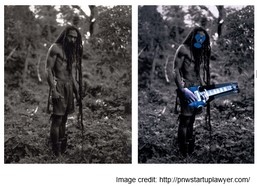
Prince copied several of Cariou’s original photographs and engaged in various transformations, including printing them, increasing their size, blurring or sharpening, adding content (sometimes in colour), and sometimes compositing multiple photographs together or with other works.

Cariou's original black and white photograph of a Rastafarian man standing on greenery is juxtaposed to the Prince's creation where the same man has some face features coloured in blue and holds an electric guitar that is also coloured blue

What do you think was the judgement?

Continue to read the article on this page on Wikipedia.

The author takes no responsibility for the content of this page, which is not intended as binding legal advice. The views are about copyright in the UK Higher Education sector context.

Using work as an inspiration – 1

Rogers v. Koons, 1992

Rogers v. Koons was a copyright case in the United States dealing with the fair use defence for parody. Please note that the judgment falls under a legal jurisdiction other than the UK.

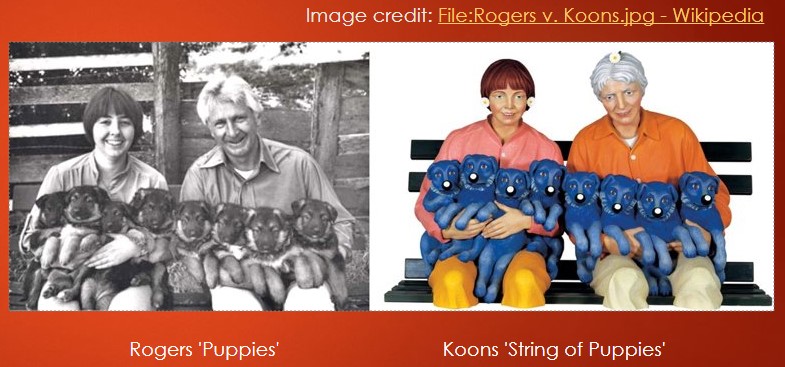
Jeff Koon made a sculpture based on one of Art Rogers’ photographs. It was for an art show on the banality of everyday items.

After removing the copyright label from a postcard of Art Rogers’ photograph, he gave it to his assistants with instructions on how to model the sculpture. He asked that as much detail be copied as possible, though the puppies were to be made blue, their noses exaggerated, and flowers to be added to the hair of the man and woman.

Roger's original black and white photograph portrays a young woman sitting beside an older man, together holding eight puppies on their laps. The juxtaposed image depicts Koon's creation of a 3D-coloured representation of the original photograph

What do you think was the judgement?

Continue to read the article on this page on Wikipedia.

The author takes no responsibility for the content of this page, which is not intended as binding legal advice. The views are about copyright in the UK Higher Education sector context.

What is fair dealing?

Fair dealing in the UK is a legal term used to establish whether a specific use of copyright material is lawful or whether it infringes copyright. There is no statutory definition of fair dealing – it will always be a matter of fact, degree, impression and interpretation in each case.

The amount should be as much as a fair-minded and honest person would consider just, and it is not an excuse to infringe copyright.

Relevant factors in determining whether a particular dealing with a work is fair include:

  • Does using the work affect the market for the original work? If the use of a work acts as a substitute for it, causing the owner to lose revenue, then it is not likely to be fair.
  • Is the amount of the work taken reasonable and appropriate? Was it necessary to use the amount that was taken? Usually, only part of a work may be used.

‘Fair dealing’ is not to be confused with ‘Fair use’, a doctrine in the law of the United States.

Other countries’ copyright laws may refer to similar variations to the concept: fair use, fair dealing, free use and fair practice all allow some lawful use or reproduction of work without having to seek permission from the copyright owner(s) or infringing their interest.

Fair dealing and the reuse of Creative Commons licensed works


Go back to Copyright overview

Go back to Exceptions in copyright

Back Home

The author takes no responsibility for the content of this page, which is not intended as binding legal advice. The views are about copyright in the UK Higher Education sector context.

This website was created using Coventry.Domains, a service of the Coventry University Group. The information, views, opinions and discussion contained on this website are those of the author(s) and do not necessarily reflect the views and opinions of the Coventry University Group. For more information on privacy, cookies, takedown requests and more, visit our policies page.