Tag: Creative Commons

Can I apply a CC licence to my work if it incorporates non-CC licensed material?

It depends on the purpose of your publication.

Technically, yes, you may apply one of the Creative Commons licences to your work even if it incorporates material used under fair dealing, which is another exception or limitation to copyright. Still, it is important to prominently mark any third-party material so re-users do not think the Creative Commons licence applies to that material.

The Creative Commons licence only applies to the rights you have in the work. For example, if your Creative Commons licensed slide deck includes a Flickr image you are using under any exceptions to copyright law, make sure to identify that image as not subject to the Creative Commons licence. For more information about incorporating work owned by others, see our page about marking third-party content.

Suppose you publish a new creation, for example, an Open Access journal article. In that case, it is better to seek permission from the copyright holder, making it clear that you will apply an open licence to the whole work. Whilst they’ll indicate to readers that their copyrighted resource is excluded from this licence, you cannot control downstream use. Unfortunately, it may increase the chance that the third-party copyright owner will reject the request, compared to a request for a ‘paywalled’ publication where distribution is more limited.

Extract from the Creative Commons’ Frequently Asked Questions webpage. It is available from https://creativecommons.org/faq/#may-i-apply-a-cc-license-to-my-work-if-it-incorporates-material-used-under-fair-use-or-another-exception-or-limitation-to-copyright [accessed on 2 February 2022]

The author takes no responsibility for the content of this page, which is not intended as binding legal advice. The views are about copyright in the UK Higher Education sector context.
How do I pick a Creative Commons licence for my work?

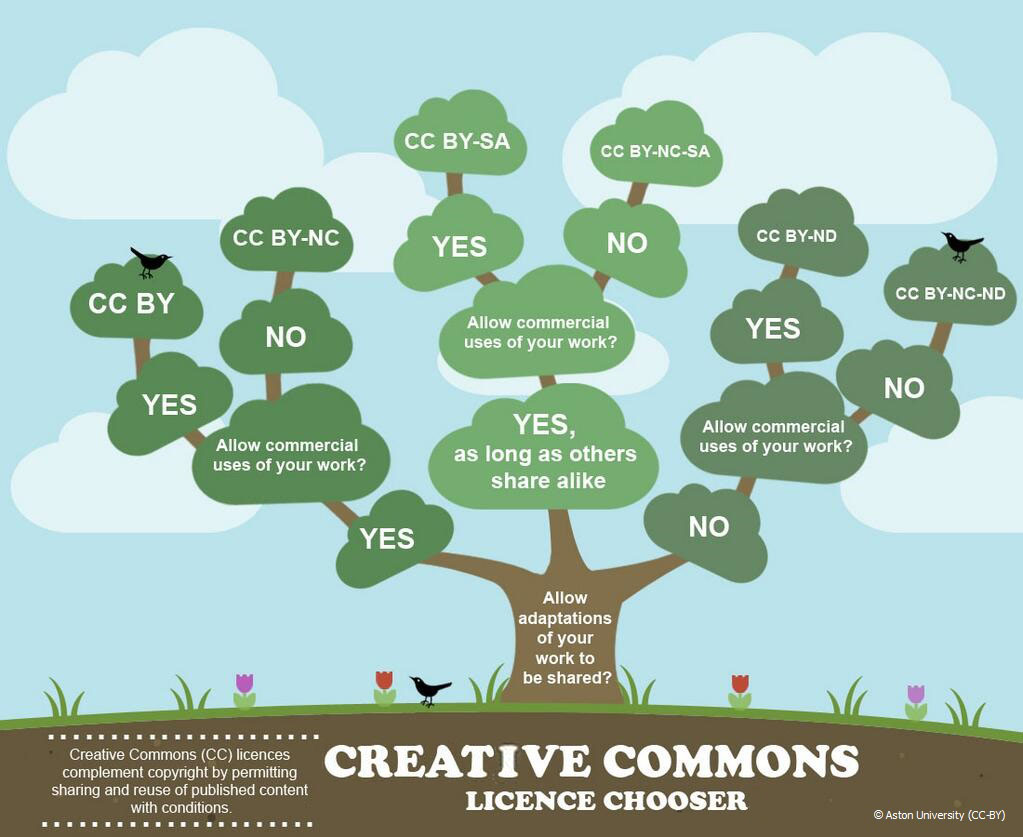
The colourful infographic from Aston University (licensed CC-BY) is a tree diagram explaining how creators can choose different Creative Commons licenses. It presents green leaves on the tree branches, a blue sky with clouds in the background, and a grassy ground with flowers. The overall design is friendly and visually appealing, making the information accessible and easy to understand. The image is titled "Creative Commons Licence Chooser” and briefly explains Creative Commons licences. It reads: "Creative Commons (CC) licences complement copyright by permitting sharing and reuse of published content with conditions." The Tree Diagram Structure has multiple branches, each representing a different Creative Commons licence. The branches split on whether the licence will allow commercial use and whether adaptations of the work are permitted. Each branch has green leaves with text indicating the licence type and answers to specific questions about the licence conditions. Starting from the trunk, the first question is, “Allow adaptations of your work to be shared?”. A positive answer will follow with a further question, “Allow commercial uses of your work?” if the chooser’s answer is positive, then the work will be licensed CC BY (Attribution); if it is negative, the licence will be CC BY-NC (Attribution-NonCommercial). If the answer to the first question, “Allow adaptations of your work to be shared?” was positive if others share alike, a further question will follow again to ascertain whether commercial uses of the work will be allowed: if the chooser’s answer is positive, then the work will be licensed CC BY-SA (Attribution-ShareAlike); if it is negative, the licence will be CC BY-NC-SA (Attribution-NonCommercial-ShareAlike). If the answer to the first question, “Allow adaptations of your work to be shared?” was negative, a further question will follow again to ascertain whether commercial uses of the work will be allowed: if the chooser’s answer is positive, then the work will be licensed CC BY-ND (Attribution-NoDerivs); if it is negative, the licence will be; CC BY-NC-ND (Attribution-NonCommercial-NoDerivs)

Please note that commonly, the Non-Derivative element (ND) of a Creative Commons licence makes the work released NOT with an open licence.

Find here a further infographic, also from Aston University:

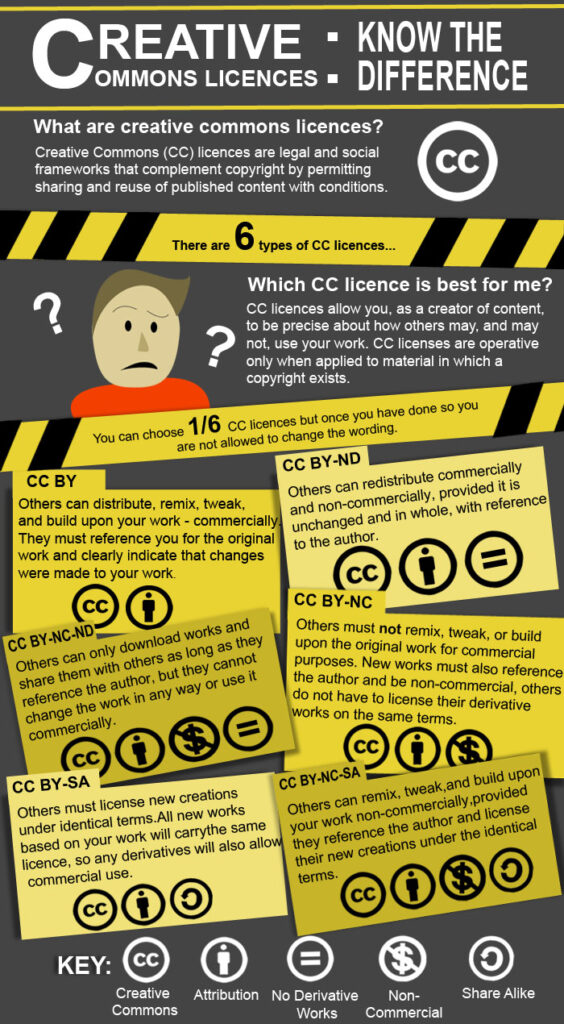
The image is an infographic titled "Creative Commons Licences - Know the Difference". It explains Creative Commons (CC) licences, which allow content creators to specify how others can use their work. There are six types of CC licences: CC BY (it allows others to distribute, remix, tweak, and build upon the work, even commercially, as long as credit is given to the original creator); CC BY-SA (others can remix, tweak, and build upon the work even for commercial purposes, as long as they credit the creator and license new creations under identical terms); CC BY-ND (it allows for redistribution, commercial and non-commercial, as long as it is passed along unchanged and with credit to the creator); CC BY-NC (others can remix, tweak, and build upon the work non-commercially, and their new works must acknowledge the creator and be non-commercial; CC BY-NC-SA (others can remix, tweak, and build upon the work non-commercially, as long as they credit the creator and license new creations under identical terms; and CC BY-NC-ND (it allows others to download the works and share them with others as long as they credit the creator, but they can’t change them in any way or use them commercially). The infographic includes icons representing each licence type and conditions, such as Attribution, No Derivative Works, Non-Commercial, and Share Alike.

Forward to Considerations on remixed/adapted and derivative works for Creative Commons licensed material

Back to How do you reference and acknowledge Creative Commons licensed works?

Back to Creative Commons licences

Back to Open licences

Back Home

The author takes no responsibility for the content of this page, which is not intended as binding legal advice. The views are about copyright in the UK Higher Education sector context.
Creative Commons licences

Find here at a glance information on the Creative Commons:

1. What are the Creative Commons licences?
2. Fair dealing and the reuse of Creative Commons licensed works
3. What are the elements of the Creative Commons?
4. What are the six Creative Commons licences?
5. How do the Creative Commons licences work technically?
6. How do you reference and acknowledge Creative Commons licensed works?
7. How do I pick a Creative Commons licence for my work?
8. Considerations on remixed/adapted and derivative works for Creative Commons licensed material
9. Creative Commons’ adapters and remixers licence chart
10. How can I use works on Wikimedia and Wikipedia?

See also:

What are Open Educational Resources?

What is Open Access in scholarship?


Back to Open licences

Back to Licences

Back Home

The author takes no responsibility for the content of this page, which is not intended as binding legal advice. The views are about copyright in the UK Higher Education sector context.
What are open licences?

A free or open licence is a licensing agreement that allows individuals to reuse another creator’s work. This use is granted by the copyright owner at the start.

Some of the most common licences are as follows:

Please note that works in the public domain are free to be used, but licences do not regulate them.


Back to Licences

Back Home

The author takes no responsibility for the content of this page, which is not intended as binding legal advice. The views are about copyright in the UK Higher Education sector context.
What are Open Educational Resources?

Open Educational Resources (OER) are educational materials that are shared at no cost with legal permissions for the public to freely use, share, and build upon the content (either in the public domain or under a CC licence permitting derivative works, such as CC BY, CC BY-SA, CC BY-NC, or CC BY-NC-SA.

Educational resources are open when providing the public with permission to engage in the 5R activities:

  1. Retain – permission to make, own and control copies of the content (download, duplicate, store and manage)
  2. Reuse – permission to use the content in many ways (class, study group, website and video)
  3. Revise – permission to adapt, adjust, modify, or alter the content itself (translate into another language)
  4. Remix – permission to combine content with other material to create something new (mashup)
  5. Redistribute – permission to share the original content, your revisions, or your remixes with others

The author takes no responsibility for the content of this page, which is not intended as binding legal advice. The views are about copyright in the UK Higher Education sector context.

What is Open Access in scholarship?

The Open Access an orange open lock symbol.

Open Access (OA) is a set of principles and practices through which research output is distributed online free of charge.

OA aim to increase the impact and exploitation of scholarly communications in opposition to the limiting nature of the traditional fee-paying system.

Components of OA include:

  • Authors keep their copyright
  • Access to output without embargo
  • Application of a CC licence that enables text and data mining

A publication realised with a Creative Commons licence that includes the NonDerivative element is not considered Open Access.


GREEN Open Access

Usually, an earlier version (manuscript) of a publication is made freely available in a repository (self-archiving) through, for example:

  • University research repositories
  • Subject repositories, such as arXv or PubMed
  • Repositories managed by research funders, such as an example Zenodo

GOLD Open Access

The published version of the publication is made freely available upon publication by the publisher with an open licence. Open Access journals may charge an Article Processing Charge (APC) to make it open.

The author takes no responsibility for the content of this page, which is not intended as binding legal advice. The views are about copyright in the UK Higher Education sector context.
Creative Commons adapters and remixers licence chart

The following chart from the Creative Commons is a guide to ensure that adaptations comply with the licences’ terms.

The left-hand column identifies the licence of the original work to use in the adaptation.

By looking across the table, it shows the available licences for the new creation.

The table is titled "Adapter's licence chart" and details the compatibility of different licences for adapting works based on their original licence. It helps determine which licences are compatible for adapting works, ensuring proper usage and adherence to licensing terms. The table is organised with the "Status of original work" listed in the leftmost column and the "Adapter's licence" types listed across the top row. The intersections of these rows and columns are colour-coded to indicate compatibility: green cells represent permissible combinations, yellow cells represent permissible combinations with some restrictions, and grey cells represent combinations that are not allowed. Colour-coded details: for Public Domain as original work, all adapter licences are green; for  By Attribution as original work, it is green for BY, BY-NC, BY-NC-ND, BY-NC-SA, BY-SA, BY-ND and yellow for PD; for  By Attribution NonCommercial as original work, it is green for BY-NC, BY-NC-ND, BY-NC-SA and yellow for BY-NC, BY-ND, BY-SA, PD; for  By Attribution NonCommercial-NoDerivs as original work, it is grey for all adapter licences; for  By Attribution NonCommercial-ShareAlike as original work, it is green for BY-NC-SA only and grey for all other adapter licences; for By Attribution NoDerivs as original work, it is grey for all adapter licences; for By Attribution ShareAlike as original work, it is green for BY-SA only and grey is grey for all adapter licences.

CC does not recommend using a licence if the corresponding box is yellow, although doing so is technically permitted by the licence terms.
The grey boxes indicate those licences that one may not use as an adapter’s licence.

Examples:

  • If one adapts a BY-NC work, the BY-NC will do for the adaptation.
  • If one adapts a BY work, either BY or BY-NC will do for the adaptation.
  • Work licensed with BY-SA or BY-NC-SA must have the same licence applied for the adaptation.

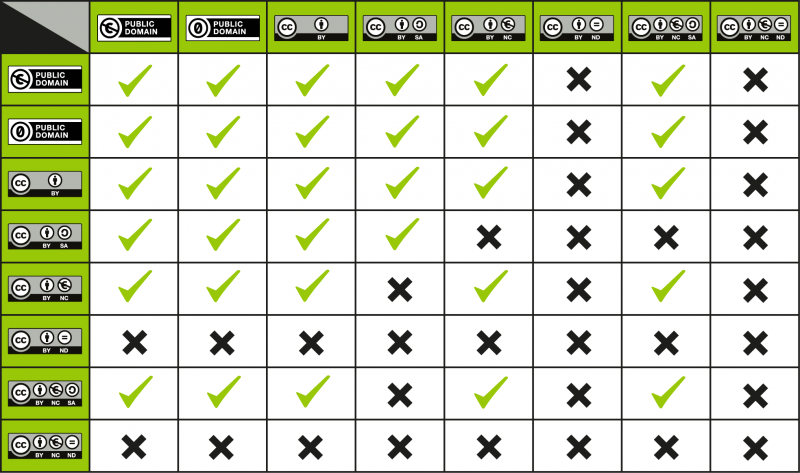
Another type of licence compatibility relates to licences when remixing more than one pre-existing work.

The chart helps users understand which Creative Commons licenses can be used together when mixing or reusing content under different licensing terms. The leftmost column lists different types of Creative Commons licenses, and the top row lists the same licenses. The intersections of these rows and columns indicate whether a specific combination of licenses is compatible, where each cell in the grid either has a checkmark (signifying that the combination of licenses is compatible) or a black "X (indicating that the combination of licenses is incompatible). In particular, Public Domain and CC BY (Attribution) are compatible with all but those with a NoDerivs element; CC BY-SA (Attribution-ShareAlike) is compatible with all but those with NonCommercial and NoDerivs elements; CC BY-NC (Attribution-NonCommercial) and CC BY-NC-SA (Attribution-NonCommercial-ShareAlike) are compatible with all but CC BY-SA (Attribution-ShareAlike) and those with a NoDerivs element; CC BY-ND Attribution-NoDerivs and CC BY-NC-ND Attribution-NonCommercial-NoDerivs are incompatible with any.

Find on the left column a licence of the works and match it with the one on the top to discover a licence that may apply to a second work:

  • A ‘tick’ at the intersection means that works under those two licences can be remixed.
  • An ‘X’ usually means the works may not be remixed.

When deciding on a licence to use for the adaptation, it is better to choose the more restrictive of the two licences on the works that are getting combined, to ease reuse for downstream users.


Forward to How can I use works on Wikimedia and Wikipedia?

Back to Considerations on remixed/adapted and derivative works for Creative Commons licensed material

Back to Creative Commons licences

Back to Open licences

Back Home

The author takes no responsibility for the content of this page, which is not intended as binding legal advice. The views are about copyright in the UK Higher Education sector context.
Considerations on remixed/adapted and derivative works for Creative Commons licensed material

An adaptation/remix brings together material from different sources to create a wholly new creation where one often cannot tell where one work ends, and another begins.

An example of an education adaptation would be an open textbook chapter that originates from multiple open educational resources in such a way that readers cannot tell which resource was used on which page without looking at endnotes

  • In all cases, one has to attribute the original work when you create an adaptation. It is important to provide attribution to the individual parts that went into making the adaptation.
  • If the original work was licensed under a NoDerivatives licence 4.0, one can make and use changes privately but cannot share it with others.
  • One has to check licence compatibility to verify which types of licensed works can be adapted into a new work; for example, if the original work was licensed under a ShareAlike licence, one can only license the new work with the same or a compatible licence (see here).

When creating an adaptation of a CC-licensed work, the simplest scenario is when one takes a single CC-licensed work and adapts it.

The more complicated scenario is when one is adapting two or more CC-licensed works into a new work. The Adapter’s Licence has to consider the original licence that will continue to govern the reuse of the elements from the original work.


Forward to Creative Commons’ adapters and remixers licence chart

Back to How do I pick a Creative Commons licence for my work?

Back to Creative Commons licences

Back to Open licences

Back Home

The author takes no responsibility for the content of this page, which is not intended as binding legal advice. The views are about copyright in the UK Higher Education sector context.
How can I use works on Wikimedia and Wikipedia?

Wikimedia and Wikipedia’s material minimum standard licence is the Creative Commons By Attribution ShareAlike.

You will be able to find material labelled with the Creative Commons By Attribution and the public domain.

Please note that Wikimedia and Wikipedia’s material are distributed under the US copyright law. Use care in selecting items licensed in the public domain are not necessarily so in the UK or other countries. It is advisable to follow the link to the original source and seek released and licence information from it rather than rely on what is displayed on Wikipedia/Wikimedia.

Assuming that the work is correctly licensed from Wikimedia, you may click on the world icon to discover the following:

  • Page URL
  • File URL
  • Preferred attribution
  • Scripts to embed both attribution and file

Back to How do I pick a Creative Commons licence for my work?

Back to Creative Commons licences

Back to Open licences

Back Home

The author takes no responsibility for the content of this page, which is not intended as binding legal advice. The views are about copyright in the UK Higher Education sector context.
How do you reference and acknowledge Creative Commons licensed works?

The complete and correct form is:


“[title]” was created by [author]. © ([year]). [owner if different]. Licensed [e.g. CC BY-SA 4.0 (URL licence). Available from [URL].

However, it is permissible to use a shorter version:

© [owner]. [licence, e.g. CC BY-NC 4.0]

Examples:

“Intellectual Property, Copyright and the Creative Commons” was created by Erica Wine. © 2020. Coventry University. Licensed CC BY 4.0.
It is an adaption of the content from the Creative Commons Certificate Course of the January 2020 Creative Commons Certificate by the Creative Commons, licensed CC BY 4.0. Available from https://certificates.creativecommons.org/about/certificate-resources-cc-by/

“Proptosis” was created by Yasser A (2017). Licensed CC BY-SA 4.0. Available from
https://commons.wikimedia.org/wiki/File:Proptosis.jpg


Forward to How do I pick a Creative Commons licence for my work?

Back to How do the Creative Commons licences work technically?

Back to Creative Commons licences

Back to Open licences

Back Home

Number © Getty Images

The author takes no responsibility for the content of this page, which is not intended as binding legal advice. The views are about copyright in the UK Higher Education sector context.

This website was created using Coventry.Domains, a service of the Coventry University Group. The information, views, opinions and discussion contained on this website are those of the author(s) and do not necessarily reflect the views and opinions of the Coventry University Group. For more information on privacy, cookies, takedown requests and more, visit our policies page.