The author takes no responsibility for the content of this page, which is not intended as binding legal advice. The views are about copyright in the UK Higher Education sector context.
Free Art Licence grants the right to freely copy, distribute, and transform creative works without any changes. It needs to be acknowledged in the following way:
[author], “[title]”, [date of the work]. [where to find the originals]. Copyleft: This is a free work. You can copy, distribute, and modify it under the terms of the Free Art License http://artlibre.org/licence/lal/en/
The author takes no responsibility for the content of this page, which is not intended as binding legal advice. The views are about copyright in the UK Higher Education sector context.
The author takes no responsibility for the content of this page, which is not intended as binding legal advice. The views are about copyright in the UK Higher Education sector context.
Open Educational Resources (OER) are educational materials that are shared at no cost with legal permissions for the public to freely use, share, and build upon the content (either in the public domain or under a CC licence permitting derivative works, such as CC BY, CC BY-SA, CC BY-NC, or CC BY-NC-SA.
Educational resources are open when providing the public with permission to engage in the 5R activities:
Retain – permission to make, own and control copies of the content (download, duplicate, store and manage)
Reuse – permission to use the content in many ways (class, study group, website and video)
Revise – permission to adapt, adjust, modify, or alter the content itself (translate into another language)
Remix – permission to combine content with other material to create something new (mashup)
Redistribute – permission to share the original content, your revisions, or your remixes with others
The author takes no responsibility for the content of this page, which is not intended as binding legal advice. The views are about copyright in the UK Higher Education sector context.
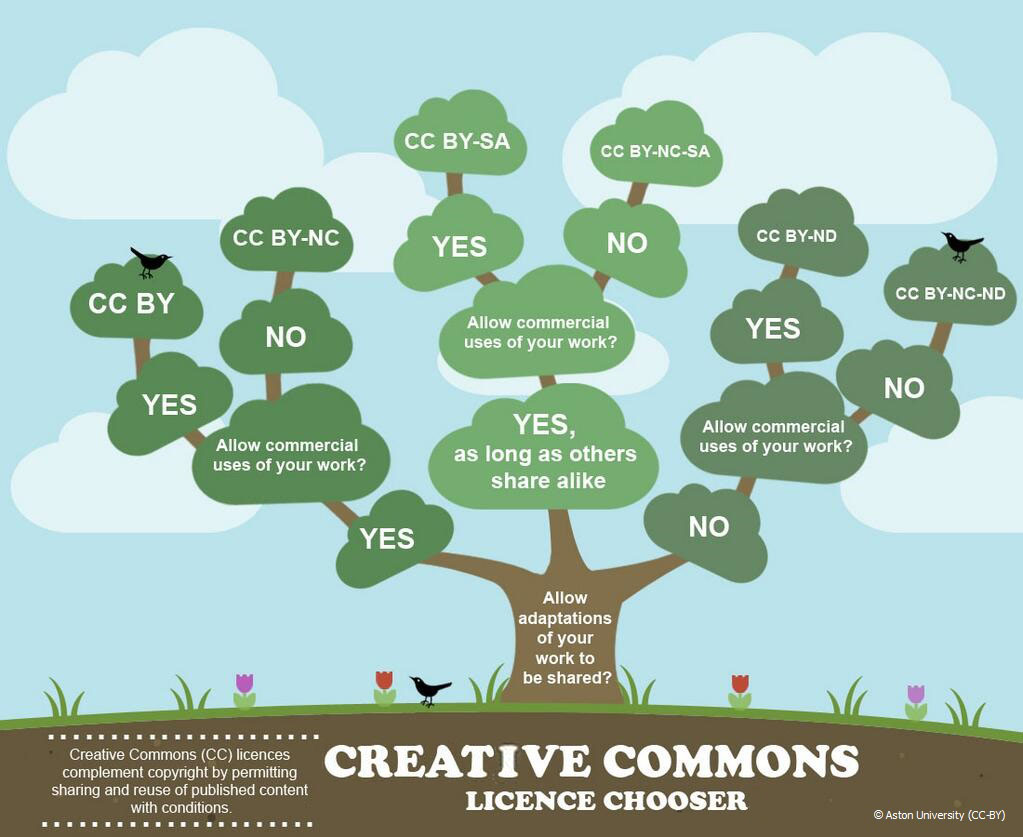
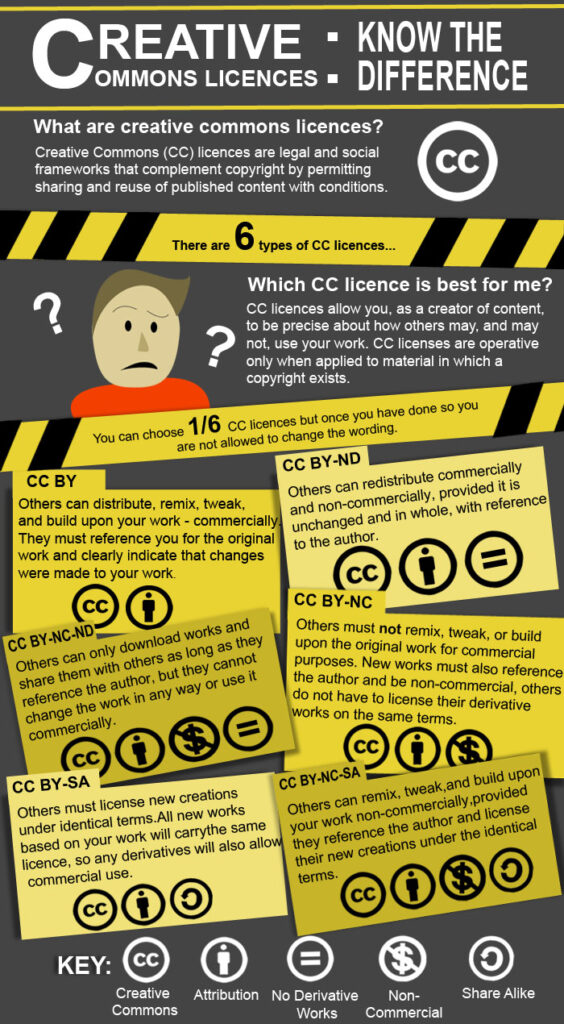
Attribution lets others distribute, remix, tweak and build upon the work, even commercially, as long as it is credited to the original owner.
BY – Credit must be given to the creator
CC BY NC
Attribution-NonCommercial lets others remix, tweak, and build upon the work non-commercially. Although the new works must acknowledge the original owner and be non-commercial, they don’t have to license their derivative works on the same terms.
BY – Credit must be given to the creator NC – Only noncommercial uses of the work are permitted
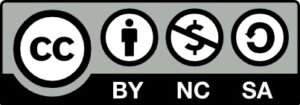
BY SA
Attribution-ShareAlike lets others remix, tweak, and build upon the work, even for commercial purposes, as long as the original copyright owner is credited and the new creation is licensed under identical terms. All new works will carry the same licence so that any derivatives will allow commercial use.
BY – Credit must be given to the creator SA – Adaptations must be shared under the same terms
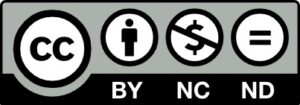
BY ND
Attribution-NoDerivs allows for commercial and non-commercial redistribution as long as it is passed along unchanged and in whole, with credit to the original copyright owner.
BY – Credit must be given to the creator ND – No derivatives or adaptations of the work are permitted
BY NC SA
Attribution-NonCommercial-ShareAlike lets others remix, tweak, and build upon the work non-commercially, as long as the original owner is credited and the licence of the new creation is under identical terms.
BY – Credit must be given to the creator NC – Only non-commercial uses of the work are permitted SA – Adaptations must be shared under the same terms
CC BY NC ND
Attribution-NonCommercial-NoDerivs is the most restrictive of the six licences, allowing others to download and share work, as long as they credit it to the original copyright owner; however, works cannot be changed in any way or used commercially.
BY – Credit must be given to the creator NC – Only non-commercial uses of the work are permitted No derivatives or adaptations of the work are permitted
In addition, CC also has two public domain tools, though they are not licences.
The author takes no responsibility for the content of this page, which is not intended as binding legal advice. The views are about copyright in the UK Higher Education sector context.
Manage Cookie Consent
We use cookies to optimise our website and our service.
Functional
Always active
The technical storage or access is strictly necessary for the legitimate purpose of enabling the use of a specific service explicitly requested by the subscriber or user, or for the sole purpose of carrying out the transmission of a communication over an electronic communications network.
Preferences
The technical storage or access is necessary for the legitimate purpose of storing preferences that are not requested by the subscriber or user.
Statistics
The technical storage or access that is used exclusively for statistical purposes.The technical storage or access that is used exclusively for anonymous statistical purposes. Without a subpoena, voluntary compliance on the part of your Internet Service Provider, or additional records from a third party, information stored or retrieved for this purpose alone cannot usually be used to identify you.
Marketing
The technical storage or access is required to create user profiles to send advertising, or to track the user on a website or across several websites for similar marketing purposes.
This website was created using Coventry.Domains, a service of the Coventry University Group. The information, views, opinions and discussion contained on this website are those of the author(s) and do not necessarily reflect the views and opinions of the Coventry University Group. For more information on privacy, cookies, takedown requests and more, visit our policies page.

 BY – Credit must be given to the creator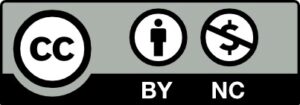
 NC – Only noncommercial uses of the work are permitted
 SA – Adaptations must be shared under the same terms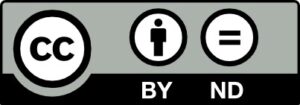
 ND – No derivatives or adaptations of the work are permitted