Tag: Jurisdiction

Using a photo for educational purposes

Merano v. The Metropolitan Museum of Art is a copyright case in the United States. Please note that the judgment falls under a legal jurisdiction other than the UK.

In 1982, the photographer Lawrence Marano shot an image of Eddie Van Halen in concert.

The Metropolitan Museum of Art used the image in an online catalogue for the 2019 exhibition “Play It Loud: Instruments of Rock and Roll,” which featured the late musician’s famous “Frankenstein” guitar.

Marano sued the museum for copyright infringement, arguing that he never granted permission for the photograph to be used. 

What do you think was the judgement?

Read the whole piece in this online article.

Dafoe, T. (2021). “The Met wins a case against a photographer who claims it posted his image of Eddie Van Halen online without permission”. [online]. ArtNet. 5 April 2021. available from https://news.artnet.com/art-world/metropolitan-museum-of-art-copyright-van-halen-1957058 [accessed on 28 January 2022].

The author takes no responsibility for the content of this page, which is not intended as binding legal advice. The views are about copyright in the UK Higher Education sector context.
Using work as an inspiration – 2

Cariou v. Prince, 2013

Cariou v. Prince is a copyright case in the United States on whether Richard Prince’s appropriation of art treatment of Patrick Cariou’s photograph was a copyright infringement or fair use.

Please note that the judgment falls under a legal jurisdiction other than the UK.

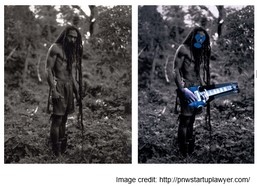
Prince copied several of Cariou’s original photographs and engaged in various transformations, including printing them, increasing their size, blurring or sharpening, adding content (sometimes in colour), and sometimes compositing multiple photographs together or with other works.

Cariou's original black and white photograph of a Rastafarian man standing on greenery is juxtaposed to the Prince's creation where the same man has some face features coloured in blue and holds an electric guitar that is also coloured blue

What do you think was the judgement?

Continue to read the article on this page on Wikipedia.

The author takes no responsibility for the content of this page, which is not intended as binding legal advice. The views are about copyright in the UK Higher Education sector context.
Using work as an inspiration – 1

Rogers v. Koons, 1992

Rogers v. Koons was a copyright case in the United States dealing with the fair use defence for parody. Please note that the judgment falls under a legal jurisdiction other than the UK.

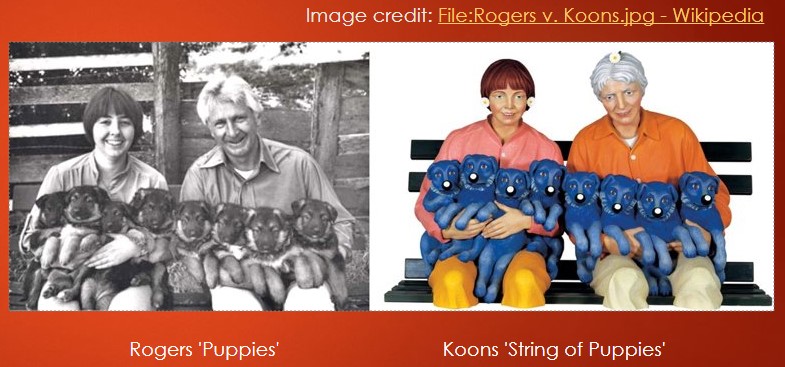
Jeff Koon made a sculpture based on one of Art Rogers’ photographs. It was for an art show on the banality of everyday items.

After removing the copyright label from a postcard of Art Rogers’ photograph, he gave it to his assistants with instructions on how to model the sculpture. He asked that as much detail be copied as possible, though the puppies were to be made blue, their noses exaggerated, and flowers to be added to the hair of the man and woman.

Roger's original black and white photograph portrays a young woman sitting beside an older man, together holding eight puppies on their laps. The juxtaposed image depicts Koon's creation of a 3D-coloured representation of the original photograph

What do you think was the judgement?

Continue to read the article on this page on Wikipedia.

The author takes no responsibility for the content of this page, which is not intended as binding legal advice. The views are about copyright in the UK Higher Education sector context.
Which licences does the Coventry University Group manage centrally?

Downloaded and scanned materials such as book chapters and journal articles is most likely subject to copyright restrictions. You may use Locate, the library catalogue, to discover the library’s holdings and obtain permalinks, or use closed-course access for quick access to resources.

However, some materials (for example, British Standards and Digimap) have territorial restrictions – students connecting from abroad cannot gain access. 

Please check with the Subject Librarian for updated information, including the licences below. 

  1. CLA licence
  2. Educational Recording Agency (ERA) Licence
  3. The university also subscribes to Box of Broadcasts (BoB), a service for UK universities that allows you to view and record TV or radio programmes on over 60 channels. Please check with the Subject Librarian for updated information on territorial restrictions.

The author takes no responsibility for the content of this page, which is not intended as binding legal advice. The views are about copyright in the UK Higher Education sector context.
How can I use works on Wikimedia and Wikipedia?

Wikimedia and Wikipedia’s material minimum standard licence is the Creative Commons By Attribution ShareAlike.

You will be able to find material labelled with the Creative Commons By Attribution and the public domain.

Please note that Wikimedia and Wikipedia’s material are distributed under the US copyright law. Use care in selecting items licensed in the public domain are not necessarily so in the UK or other countries. It is advisable to follow the link to the original source and seek released and licence information from it rather than rely on what is displayed on Wikipedia/Wikimedia.

Assuming that the work is correctly licensed from Wikimedia, you may click on the world icon to discover the following:

  • Page URL
  • File URL
  • Preferred attribution
  • Scripts to embed both attribution and file

Back to How do I pick a Creative Commons licence for my work?

Back to Creative Commons licences

Back to Open licences

Back Home

The author takes no responsibility for the content of this page, which is not intended as binding legal advice. The views are about copyright in the UK Higher Education sector context.
Fair dealing and the reuse of Creative Commons licensed works

Unless the person using the work received separate permission or relied on fair dealing or other exceptions to copyright, they are potentially liable for copyright infringement.

If someone uses a CC-licensed work without following the licence, their right to use the work ends automatically as soon as they violate its terms.

Under CC version 4.0, users of CC-licensed works who come into compliance with licence terms within 30 days of discovering they were in violation of the terms have their rights under the licence automatically reinstated.

Sometimes, these types of disputes can end up in court.
Judicial decisions have been made in various places worldwide, and no courts have ever questioned the validity of the CC licence.


Back to Exceptions in copyright

Forward to What are the elements of the Creative Commons?

Back to What are the Creative Commons licences?

Back to Creative Commons licences

Back to Open licences

Back Home

The author takes no responsibility for the content of this page, which is not intended as binding legal advice. The views are about copyright in the UK Higher Education sector context.
4. What is the public domain?

The Public Domain (PD) consists of creative works not subject to copyright to which no exclusive intellectual property rights apply (no licence can apply, not even the Creative Commons licences).

Such creative works are publicly available, and new creativity and knowledge may be built from them.

No acknowledgements are legally required, but it is proper to do so to demonstrate academic integrity.

See How do you reference and acknowledge Public Domain material?

PD allows one to do almost anything to a creation; however, a work in the PD…

  • May still be covered by moral rights in some countries
  • Could still be under copyright in some countries (limiting the use of the work where it still applies)
  • May still be subject to other IP restrictions (such as trademark protection, which is independent of copyright protection and may still exist even though the work is in the Public Domain)
  • Any reproduction of work in the public domain may be freshly subject to copyright.

There are two public domain tools:

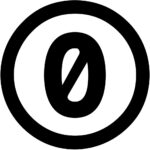
A zero with a line through it, inside a circle.
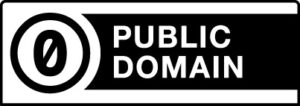
The same icon of a barred 0 with the words Public Domain, circumscribed in a rectangle.

CC0 is a legal tool to enable creators to dedicate their works to the worldwide public domain to the greatest extent possible.


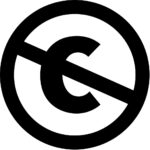
A circle with a C inside and a line running diagonally across it.
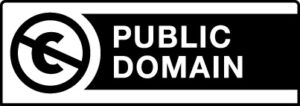
The same icon of a circle with a barred C with the words Public Domain, circumscribed in a rectangle.

The Public Domain Mark is a label used to inform the public about the public domain status of a work, and it is often used by museums and archives working with very old works. It marks works known to be free of all copyright restrictions. It is not a legal tool and has no legal effect when applied to a work.

Refer to the handy workflows on how long copyright lasts.


See also Using Wikimedia

Back Home

The author takes no responsibility for the content of this page, which is not intended as binding legal advice. The views are about copyright in the UK Higher Education sector context.
Exceptions in copyright

In some parts of the world, copyright law has some limitations and allows some exceptions (for example, ‘fair use’ and ‘fair dealing’) to ensure that the rights of the public are not unduly restricted by copyright.

Thus, by offering exceptions to copyright, the Law permits certain very specific situations where you may be permitted limited use of copyright works without the copyright owner’s permission.

Exceptions and limitations to copyright vary by country, and they have territorial jurisdiction, meaning they apply only to that specific country.

In other words, since copyright law is unique to its jurisdiction, an exception could be valid in one country but not in others.

For more details, look at the Intellectual Property Office guide Exceptions to copyright: Education and Teaching.

See some more details of exceptions permitted by the UK in copyright law, with particular application to online teaching:


Go to next What is copyrightable?

Go to previous Copyright Law

Back Home

The author takes no responsibility for the content of this page, which is not intended as binding legal advice. The views are about copyright in the UK Higher Education sector context.

Exception: parody, caricature and pastiche

It is essential to understand that this exception only permits use for the purposes of caricature, parody, or pastiche to the extent that it is fair dealing. This must not be derogatory or cause commercial harm to the original.

Please see this article on a court case

Only Fools and Horses firm sues creators of ‘cushty’ dining events


Go back to Copyright overview

Go back to Exceptions in copyright

Back Home

The author takes no responsibility for the content of this page, which is not intended as binding legal advice. The views are about copyright in the UK Higher Education sector context.

This website was created using Coventry.Domains, a service of the Coventry University Group. The information, views, opinions and discussion contained on this website are those of the author(s) and do not necessarily reflect the views and opinions of the Coventry University Group. For more information on privacy, cookies, takedown requests and more, visit our policies page.