This scenario is part of the online course Copyright and Creative Reuse in Education, designed by Bartolomeo Meletti (Learning on Screen).
The author takes no responsibility for the content of this page, which is not intended as binding legal advice. The views are about copyright in the UK Higher Education sector context.
Copyright protection starts as soon as a work is created.
The duration (length) of copyright is very complex. It depends on various factors, such as the type of work when it was created, whether it was published or unpublished, whether the author is identifiable and the geographical jurisdiction where the law applies.
Once your copyright has expired, a work falls in the public domain, and anyone can use or copy it. Any reproduction of work in the public domain may be freshly subject to copyright.
Since copyright law is territorial, one work may be in the public domain in one country but not another. In the UK, the copyright expires as follows:
Work type
Expiration
Literary, dramatic, musical and artistic works
70 years after the death of the author
Film
70 years after the death of the last of the following persons: director; author of the screenplay; author of the dialogue (if different); composer of the music specially created for the film
Sound recording
50 years from the year in which the recording was made or, if published, 70 years from publication
The author takes no responsibility for the content of this page, which is not intended as binding legal advice. The views are about copyright in the UK Higher Education sector context.
Merano v. The Metropolitan Museum of Art is a copyright case in the United States. Please note that the judgment falls under a legal jurisdiction other than the UK.
In 1982, the photographer Lawrence Marano shot an image of Eddie Van Halen in concert.
The Metropolitan Museum of Art used the image in an online catalogue for the 2019 exhibition “Play It Loud: Instruments of Rock and Roll,” which featured the late musician’s famous “Frankenstein” guitar.
Marano sued the museum for copyright infringement, arguing that he never granted permission for the photograph to be used.
The author takes no responsibility for the content of this page, which is not intended as binding legal advice. The views are about copyright in the UK Higher Education sector context.
The author takes no responsibility for the content of this page, which is not intended as binding legal advice. The views are about copyright in the UK Higher Education sector context.
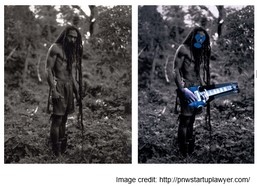
Cariou v. Prince is a copyright case in the United States on whether Richard Prince’s appropriation of art treatment of Patrick Cariou’s photograph was a copyright infringement or fair use.
Please note that the judgment falls under a legal jurisdiction other than the UK.
Prince copied several of Cariou’s original photographs and engaged in various transformations, including printing them, increasing their size, blurring or sharpening, adding content (sometimes in colour), and sometimes compositing multiple photographs together or with other works.
The author takes no responsibility for the content of this page, which is not intended as binding legal advice. The views are about copyright in the UK Higher Education sector context.
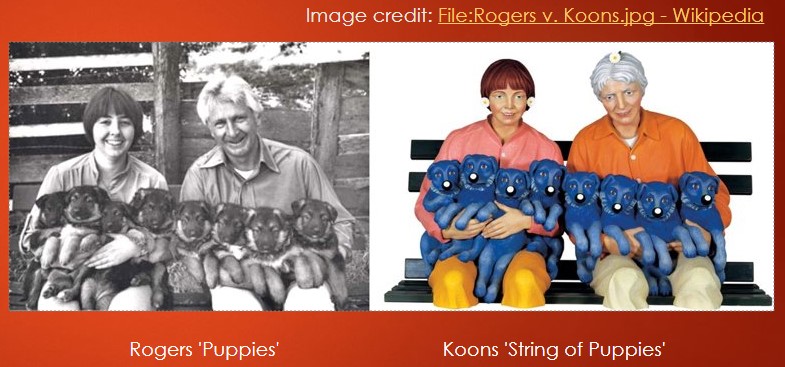
Rogers v. Koons was a copyright case in the United States dealing with the fair use defence for parody. Please note that the judgment falls under a legal jurisdiction otherthan the UK.
Jeff Koon made a sculpture based on one of Art Rogers’ photographs. It was for an art show on the banality of everyday items.
After removing the copyright label from a postcard of Art Rogers’ photograph, he gave it to his assistants with instructions on how to model the sculpture. He asked that as much detail be copied as possible, though the puppies were to be made blue, their noses exaggerated, and flowers to be added to the hair of the man and woman.
The author takes no responsibility for the content of this page, which is not intended as binding legal advice. The views are about copyright in the UK Higher Education sector context.
Manage Cookie Consent
We use cookies to optimise our website and our service.
Functional
Always active
The technical storage or access is strictly necessary for the legitimate purpose of enabling the use of a specific service explicitly requested by the subscriber or user, or for the sole purpose of carrying out the transmission of a communication over an electronic communications network.
Preferences
The technical storage or access is necessary for the legitimate purpose of storing preferences that are not requested by the subscriber or user.
Statistics
The technical storage or access that is used exclusively for statistical purposes.The technical storage or access that is used exclusively for anonymous statistical purposes. Without a subpoena, voluntary compliance on the part of your Internet Service Provider, or additional records from a third party, information stored or retrieved for this purpose alone cannot usually be used to identify you.
Marketing
The technical storage or access is required to create user profiles to send advertising, or to track the user on a website or across several websites for similar marketing purposes.
This website was created using Coventry.Domains, a service of the Coventry University Group. The information, views, opinions and discussion contained on this website are those of the author(s) and do not necessarily reflect the views and opinions of the Coventry University Group. For more information on privacy, cookies, takedown requests and more, visit our policies page.