Author: Erica Levi

Authorship and ownership of copyright

According to the Copyright, Designs and Patents Act 1988, the author of a work is the first person who creates it and usually is also the first owner of any copyright.

Type of workAuthor
Literary, dramatic, musical and artistic workAuthor
Sound recordingProducer
FilmProducer and principal director
BroadcastPerson making the broadcast
Typographical arrangements of published materialPublisher

Some authors may have clauses in their contractual agreements that transfer copyright ownership. If an employee creates the work during employment, their employer is the first owner of any copyright in the work subject to any agreement to the contrary. Therefore, from the onset, one should make oneself aware of any clauses that may restrict one’s own rights on teh material created.

The standard contract of employment in most of the higher education establishments in the UK will include a clause that works created whilst carrying out employment duties belong to the institution.   

Upon publication of work, some authors sign a transfer agreement form where they assign or transfer their copyright ownership to another person or entity, for example, a publisher.

Economic and moral rights

Copyright consists of a bundle of economic rights and moral rights.

Unlike economic rights, moral rights cannot be licensed or assigned to another person.

In the UK, moral rights are finite and last only as long as the work is in copyright and can be waived by the author.

Economic rights

  • Reproduction right to copy the work
  • Distribution right to issue copies of the work to the public
  • Rental right to rent or lend the work to the public
  • Public performance right to perform, show, or play the work in public
  • Communication right to communicate the work to the public
  • Adaptation right to adapt the work or do any of the above concerning an adaptation

The economic rights are

  • Exclusive: the copyright owners can exclude others from making these uses of their work without permission unless the use is otherwise permitted by law (for example, through exceptions).
  • Exhaustive of the distribution right: once a copy of a work is distributed within a territory, the copyright owner of the work cannot control the distribution of that copy any longer

Moral rights

  • Right of attribution: the right to be identified as the author of the work
  • Right of integrity: the right to object to the derogatory treatment of a work
  • Right to object to false attribution of the work
  • Right of privacy in privately commissioned photographs and films.

The author takes no responsibility for the content of this page, which is not intended as binding legal advice. The views are about copyright in the UK Higher Education sector context.

Can I apply a CC licence to my work if it incorporates non-CC licensed material?

It depends on the purpose of your publication.

Technically, yes, you may apply one of the Creative Commons licences to your work even if it incorporates material used under fair dealing, which is another exception or limitation to copyright. Still, it is important to prominently mark any third-party material so re-users do not think the Creative Commons licence applies to that material.

The Creative Commons licence only applies to the rights you have in the work. For example, if your Creative Commons licensed slide deck includes a Flickr image you are using under any exceptions to copyright law, make sure to identify that image as not subject to the Creative Commons licence. For more information about incorporating work owned by others, see our page about marking third-party content.

Suppose you publish a new creation, for example, an Open Access journal article. In that case, it is better to seek permission from the copyright holder, making it clear that you will apply an open licence to the whole work. Whilst they’ll indicate to readers that their copyrighted resource is excluded from this licence, you cannot control downstream use. Unfortunately, it may increase the chance that the third-party copyright owner will reject the request, compared to a request for a ‘paywalled’ publication where distribution is more limited.

Extract from the Creative Commons’ Frequently Asked Questions webpage. It is available from https://creativecommons.org/faq/#may-i-apply-a-cc-license-to-my-work-if-it-incorporates-material-used-under-fair-use-or-another-exception-or-limitation-to-copyright [accessed on 2 February 2022]

The author takes no responsibility for the content of this page, which is not intended as binding legal advice. The views are about copyright in the UK Higher Education sector context.

How long does copyright last?

Copyright protection starts as soon as a work is created.

The duration (length) of copyright is very complex. It depends on various factors, such as the type of work when it was created, whether it was published or unpublished, whether the author is identifiable and the geographical jurisdiction where the law applies.

Once your copyright has expired, a work falls in the public domain, and anyone can use or copy it. Any reproduction of work in the public domain may be freshly subject to copyright.

Since copyright law is territorial, one work may be in the public domain in one country but not another. In the UK, the copyright expires as follows:

Work typeExpiration
Literary, dramatic, musical and artistic works70 years after the death of the author
Film70 years after the death of the last of the following persons: director; author of the screenplay; author of the dialogue (if different); composer of the music specially created for the film
Sound recording50 years from the year in which the recording was made or, if published, 70 years from publication
Broadcasts50 years from transmission
Typographical arrangements25 years from publication
Summary
© The National Archive, available from here [accessed on 2 February 2022]
© The National Archive, available from here [accessed on 2 February 2022].

The author takes no responsibility for the content of this page, which is not intended as binding legal advice. The views are about copyright in the UK Higher Education sector context.

Using a photo for educational purposes

Merano v. The Metropolitan Museum of Art is a copyright case in the United States. Please note that the judgment falls under a legal jurisdiction other than the UK.

In 1982, the photographer Lawrence Marano shot an image of Eddie Van Halen in concert.

The Metropolitan Museum of Art used the image in an online catalogue for the 2019 exhibition “Play It Loud: Instruments of Rock and Roll,” which featured the late musician’s famous “Frankenstein” guitar.

Marano sued the museum for copyright infringement, arguing that he never granted permission for the photograph to be used. 

What do you think was the judgement?

Read the whole piece in this online article.

Dafoe, T. (2021). “The Met wins a case against a photographer who claims it posted his image of Eddie Van Halen online without permission”. [online]. ArtNet. 5 April 2021. available from https://news.artnet.com/art-world/metropolitan-museum-of-art-copyright-van-halen-1957058 [accessed on 28 January 2022].

The author takes no responsibility for the content of this page, which is not intended as binding legal advice. The views are about copyright in the UK Higher Education sector context.

Using work as an inspiration – 2

Cariou v. Prince, 2013

Cariou v. Prince is a copyright case in the United States on whether Richard Prince’s appropriation of art treatment of Patrick Cariou’s photograph was a copyright infringement or fair use.

Please note that the judgment falls under a legal jurisdiction other than the UK.

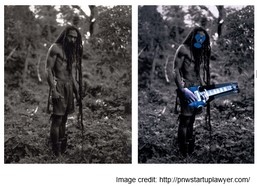
Prince copied several of Cariou’s original photographs and engaged in various transformations, including printing them, increasing their size, blurring or sharpening, adding content (sometimes in colour), and sometimes compositing multiple photographs together or with other works.

Cariou's original black and white photograph of a Rastafarian man standing on greenery is juxtaposed to the Prince's creation where the same man has some face features coloured in blue and holds an electric guitar that is also coloured blue

What do you think was the judgement?

Continue to read the article on this page on Wikipedia.

The author takes no responsibility for the content of this page, which is not intended as binding legal advice. The views are about copyright in the UK Higher Education sector context.

Using work as an inspiration – 1

Rogers v. Koons, 1992

Rogers v. Koons was a copyright case in the United States dealing with the fair use defence for parody. Please note that the judgment falls under a legal jurisdiction other than the UK.

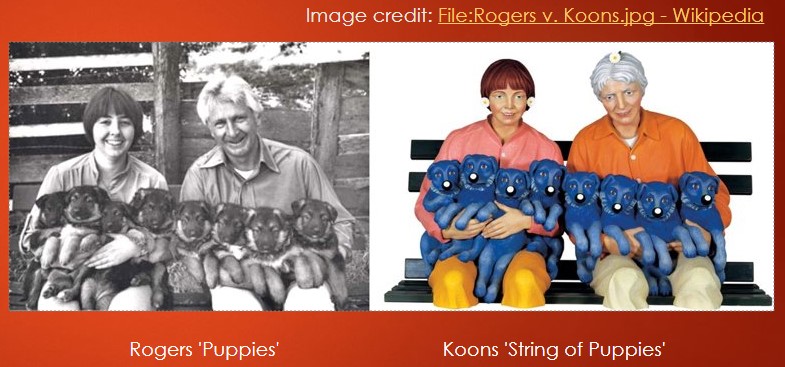
Jeff Koon made a sculpture based on one of Art Rogers’ photographs. It was for an art show on the banality of everyday items.

After removing the copyright label from a postcard of Art Rogers’ photograph, he gave it to his assistants with instructions on how to model the sculpture. He asked that as much detail be copied as possible, though the puppies were to be made blue, their noses exaggerated, and flowers to be added to the hair of the man and woman.

Roger's original black and white photograph portrays a young woman sitting beside an older man, together holding eight puppies on their laps. The juxtaposed image depicts Koon's creation of a 3D-coloured representation of the original photograph

What do you think was the judgement?

Continue to read the article on this page on Wikipedia.

The author takes no responsibility for the content of this page, which is not intended as binding legal advice. The views are about copyright in the UK Higher Education sector context.

How can I reference an image without knowing the original source?

If you wish to reuse an image or diagram, reference it. If you do not know the original source to cite, you can use image reverse search engines such as Tineye.

The site will be able to upload the image or insert a URL. The filters will enable you to find the other places where the image has been used; following the links, you will see either the source or information about it.

The author takes no responsibility for the content of this page, which is not intended as binding legal advice. The views are about copyright in the UK Higher Education sector context.

This website was created using Coventry.Domains, a service of the Coventry University Group. The information, views, opinions and discussion contained on this website are those of the author(s) and do not necessarily reflect the views and opinions of the Coventry University Group. For more information on privacy, cookies, takedown requests and more, visit our policies page.