Author: Erica Levi

Can I make a transcript from a third party owned video?

Creating a transcript from a third-party-owned resource constitutes an adaptation, and it can only be done with the copyright holder’s permission.

There is, therefore, a discrepancy between copyright law and accessibility regulations.

The best approach is to contact the copyright owner and seek consent.

If the owner withholds it, it is possible to summarise, cite and comment on the material.


Template to seek permission to create transcripts

RE: Permission request: “XXXXXX”

Hello,

I seek permission to upload your [e.g. YouTube] video “[XXXXXXXXXX]” ([link]) in our online course as part of the material available to students of [XXXX] University degree.

Our courses are available worldwide to our students through platforms accessible to students logging in.

Whilst we can link to your resource, we would instead upload it to mitigate any accessibility and blocking issues that some of our international learners may encounter with content on the YouTube platform that is banned in some countries.

Please let me know if:

  1. You are authorised to provide permission for the reuse of the material in such a manner
  2. We have permission to reuse the material on our online course
  3. We have permission to create caption and transcript files to aid accessibility for our disabled students
  4. Any further details on the wording and placement of any statements of attribution
  5. Whether there was a higher-quality version we could access.

Kind regards,

XXXXXXX

Can I upload broadcasts and movies clips?

What about hyperlinks and copyright?

Can I show clips or whole movies online?

Can I link to YouTube?

Can I use TED Talks?

Can I link to videos and films?

The author takes no responsibility for the content of this page, which is not intended as binding legal advice. The views are about copyright in the UK Higher Education sector context.
Can I edit a video?

You can only make edits with explicit permission from the rights-holder, who might be unable to grant it for licencing reasons.


Under no circumstance. you can remove the copyright and acknowledgement notes.

Can I link to videos and films?

Can I make a transcript or a third party owned video?

Can I link to YouTube?

Can I use TED Talks?

Can I show clips or whole movies online?

The author takes no responsibility for the content of this page, which is not intended as binding legal advice. The views are about copyright in the UK Higher Education sector context.

Can I show clips or whole movies online?

It is permitted for the sole purposes of illustration for instruction, as long as its use is fair, with clear evidence of its educational and non-commercial purposes and appropriately acknowledged. 

You must be able to justify why the students need to watch before and then clips face-to-face for a teaching/educational purpose. It would undoubtedly be for you as an academic to defend the showing/copying of the entire work. If you were planning to copy for teaching and the film isn’t available via any other source, I feel there is an argument to rely on the education exception.

It still represents a risk to your university and might be worth checking with your legal team, so the use needs to be assessed on a case-by-case basis to see if the following was met.

  • A full acknowledgement in the metadata. 
  • Recording can only be available to students for two days and then must be permanently deleted. 
  • The recording is only available to students studying on the unit and is password protected. 
  • Students cannot download the recording. 
  • A message in the metadata that reads this is ‘Made available under Section 32 of CDPA, 1988 and must not be copied or distributed by students’. 
  • Justification by the academic for showing the entire work rather than a clip.

Please note that material available through a Higher Education subscription, such as Box of Broadcasts (BoB), has territorial restrictions, and students connecting from abroad cannot gain access.  

Can I upload broadcasts and movie clips?

What about hyperlinks and copyright?

Can I make a transcript or a third-party-owned video?

Can I link to YouTube?

Can I use TED Talks?

Can I link to videos and films?

The author takes no responsibility for the content of this page, which is not intended as binding legal advice. The views are about copyright in the UK Higher Education sector context.

Can I upload broadcasts and movie clips?

Broadcasters and producers are unlikely to allow uploading and even editing their material.

Licensing broadcasts and movies can be very expensive.

Copyright exceptions may sometimes apply, but it is a grey area in copyright law.
It is always a matter of weighing the importance of the resource in the context of the teaching. Is it essential for that learning or just an add-on?

Care should be taken to record the reasoning for applying exceptions to the UK copyright law in case of future challenges.

In all cases, the correct acknowledgements and references are mandatory.

Some productions and broadcasters’ output have territorial restrictions (e.g. the BBC), and care should be taken to ensure that students residing abroad will not be penalised for being unable to access the recording.

Can I show clips or whole movies online?

What about hyperlinks and copyright?

Can I make a transcript or a third party owned video?

Can I link to YouTube?

Can I use TED Talks?

Can I link to videos and films?

The author takes no responsibility for the content of this page, which is not intended as binding legal advice. The views are about copyright in the UK Higher Education sector context.

Can I link to videos and films?

We can broadly assume that material hosted on organisations’ official channels is legally available, and consequently, we can link and embed them. More care will be necessary when linking to private posts in copyright infringement. You must be cautious, especially where part of the footage is from blockbusters and stock collections. 

Videos freely available on the internet may still be protected by copyright, and you need to obtain permission from the rights-holder before copying them. Not all material marked as free to use on the Internet is meant to be distributed freely: material might be incorrectly annotated, such as some posted on YouTube and Vimeo. 

What about hyperlinks and copyright?

Can I make a transcript or a third party owned video?

Can I link to YouTube?

Can I use TED Talks?

Can I show clips or whole movies online?

Can I upload broadcasts and movie clips?

TThe author takes no responsibility for the content of this page, which is not intended as binding legal advice. The views are about copyright in the UK Higher Education sector context

How much text can I copy?

In the UK, no statutory measure defines the quantity of text that can be copied. It has to be done so that a “fair-minded and honest person” would consider it just and that it is not used as an excuse to infringe copyright.  

You may paraphrase text when appropriate, but remember to reference it correctly, using Coventry University Referencing Guidelines. Include official links to referenced resources, such as official articles, landing pages, or officially uploaded material. 

The author takes no responsibility for the content of this page, which is not intended as binding legal advice. The views are about copyright in the UK Higher Education sector context.

How do I link to e-published articles?

At times, material usually available through subscription may appear available from other websites.

Sometimes, this is legitimate (for example, through institutional repositories and permitted subject repositories, such as PubMed and arXiv). However, at other times, it is in breach of copyright law: for example, some articles on ResearchGate and Academia.edu are sometimes available without the copyright owners’ permission.

A copyright owner is not necessary the author or creator

We recommend not linking to ResearchGate, Academia.edu and personal web pages. 

Exercise care to ensure that the linked resource is available legally. It is unlawful to purposely link to illegally hosted resources on the Internet. 

We recommend that you include a complete reference using the APA Style reference, which mandates the inclusion of a hyperlinked Digital Object Identifier (DOI) (usually starting with https://doi.org/10…).  

This link is a permalink that takes users to the article’s landing page on the publisher’s website. Students will be able to access the full text according to these conditions: 

  • The article was published in open access 
  • The publisher has made the document accessible (though it could be subject to territorial and temporal restrictions)  
  • The Lanchester Library must have a subscription to the resource (off-campus users may have to log in via OpenAthens or Shibboleth), without which the user will receive an error message or be prompted for payment. 

Providing a permalink to resources through Locate, following the correct reference details is possible. 

What about hyperlinks and copyright?

How do I link to e-published articles?

Why shouldn’t we link directly to PDFs?

How do I find a legal version of an e-publication?

How do I reference sources?

What about hyperlinks and copyright?

The author takes no responsibility for the content of this page, which is not intended as binding legal advice. The views are about copyright in the UK Higher Education sector context.

What about hyperlinks and copyright?

Several court cases have set presidents in Law. In short, nobody can demand a fee for linking to a lawfully posted resource freely available online.

A copyright owner is not necessary the author or creator

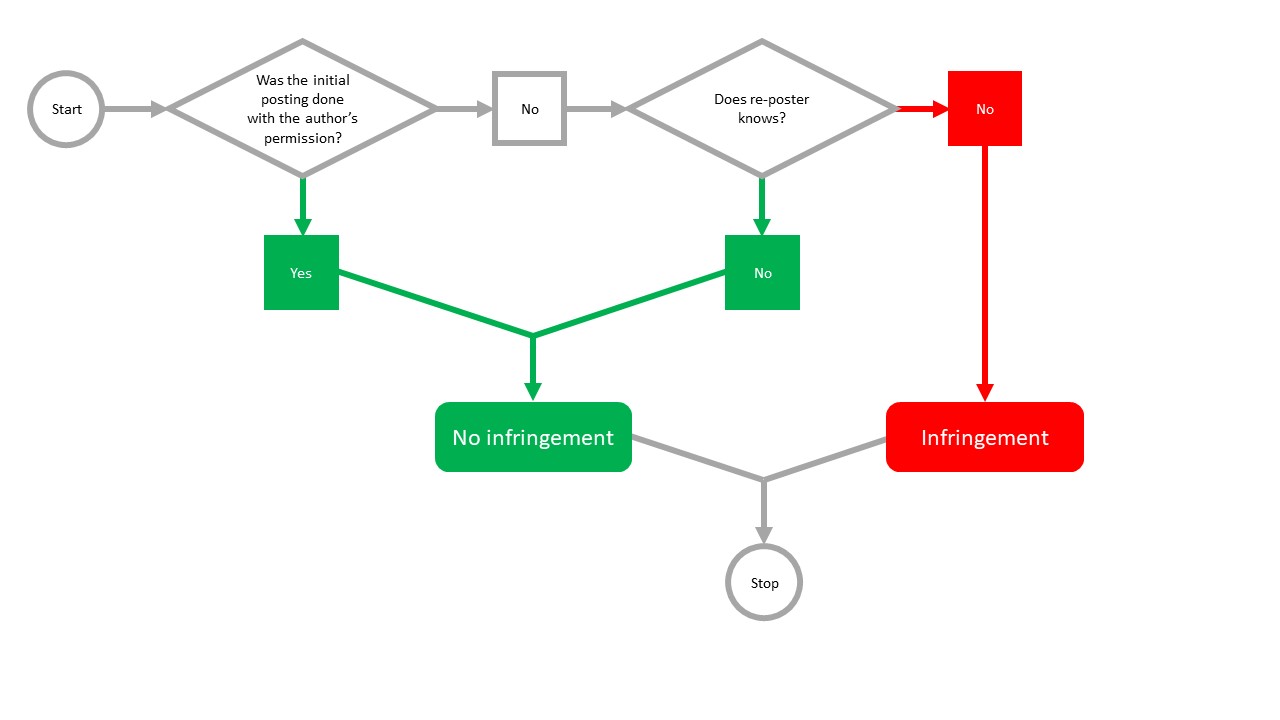
The main question for a user wanting to post a link is whether the initial posting was done with the copyright owner’s consent.

There is no infringement if the copyright owner gave permission for the original posting. There is no infringement either if the re-poster was unaware that the copyright owner did not grant permission. However, there is infringement id the re-poster is aware that the original post was done without consent of the copyright owner.
Decision workflow

How do I link to e-published articles?

How do I reference sources?

How do I find a legal version of an e-publication?

Why shouldn’t we link directly to PDFs?

Can I link to videos and films?

The author takes no responsibility for the content of this page, which is not intended as binding legal advice. The views are about copyright in the UK Higher Education sector context.

Can I upload a chapter or an article?

Including downloaded and scanned materials such as book chapters and journal articles is most likely subject to copyright restrictions. The university has the CLA Licence that covers most UK publications and some US and other international publishers. The CLA Licence allows for copying and distributing limited amounts of material without requesting permission every time. Contact your Subject Librarian for more information on whether your re-use of material is covered under the licence. 

The author takes no responsibility for the content of this page, which is not intended as binding legal advice. The views are about copyright in the UK Higher Education sector context.

Copying and creativity

How do we balance copying and creativity? Is there a boundary between building upon somebody else’s work and just plain copying? 

The video makes the case for understanding copying as a positive phenomenon that helps us learn, innovate, develop, and engage with others.

Copyright pertains to both the use and creation of work and the following video demonstrates that it is not just a set of rules but an exciting world worth exploring.

See the following links:

What is copyrightable?

Copyright Law

Exceptions in copyright


Go to next What is copyright?

Go to the previous What is Intellectual Property (IP)?

Back Home

The author takes no responsibility for the content of this page, which is not intended as binding legal advice. The views are about copyright in the UK Higher Education sector context.

This website was created using Coventry.Domains, a service of the Coventry University Group. The information, views, opinions and discussion contained on this website are those of the author(s) and do not necessarily reflect the views and opinions of the Coventry University Group. For more information on privacy, cookies, takedown requests and more, visit our policies page.