Tag: Copyright protection

Exception: illustration for instruction

A limited amount of material can be used to illustrate a point in a lesson.

Additionally, several exceptions allow copyright works to be used for educational purposes, such as:

  • Copying of works in any medium (meaning minor uses, such as displaying a few lines of poetry on an interactive whiteboard, are permitted, unlike uses which would undermine sales of teaching material) as long as the use is
    • solely to illustrate a point
    • not done for commercial purposes
    • accompanied by a sufficient acknowledgement, and
    • the use is considered fair dealing.
  • Performing, playing or showing copyrighted works in a school, university or other educational establishments for educational purposes. However, it only applies if the audience is limited to teachers, pupils and others directly connected with the activities of the establishment.
  • If permitted under specific licences such as CLA and ERA licences.

Go back to Copyright overview

Go back to Exceptions in copyright

Back Home

The author takes no responsibility for the content of this page, which is not intended as binding legal advice. The views are about copyright in the UK Higher Education sector context.
Exception: criticism, review and reporting current events

Fair dealing with a work for the purpose of reporting current events is allowed for any copyrighted work other than a photograph. In all cases, sufficient acknowledgement will be required.


Go back to Copyright overview

Go back to Exceptions in copyright

Back Home

The author takes no responsibility for the content of this page, which is not intended as binding legal advice. The views are about copyright in the UK Higher Education sector context.

Exception: non-commercial research and private study exception (s29)

A user can copy limited extracts of works when the use is non-commercial research or private study, but you must be genuinely studying (like you would if you were taking a university course).

You can make a copy only if you have lawful access to the work.

Use is only permitted when it is fair dealing; copying the whole work would not generally be considered as such.

In assessing whether your use of the work is permitted, you must ascertain if there is any financial impact on the copyright owner because of your use. Where the effect is not significant, the use may be acceptable.

If your use is for non-commercial research, you must ensure that sufficient acknowledgements support the work you reproduce.

Where a copy of a work has been made under this exception, copyright is infringed if the copy is transferred to any other person.


Go back to Copyright overview

Go back to Exceptions in copyright

Back Home

The author takes no responsibility for the content of this page, which is not intended as binding legal advice. The views are about copyright in the UK Higher Education sector context.

What is fair dealing?

Fair dealing in the UK is a legal term used to establish whether a specific use of copyright material is lawful or whether it infringes copyright. There is no statutory definition of fair dealing – it will always be a matter of fact, degree, impression and interpretation in each case.

The amount should be as much as a fair-minded and honest person would consider just, and it is not an excuse to infringe copyright.

Relevant factors in determining whether a particular dealing with a work is fair include:

  • Does using the work affect the market for the original work? If the use of a work acts as a substitute for it, causing the owner to lose revenue, then it is not likely to be fair.
  • Is the amount of the work taken reasonable and appropriate? Was it necessary to use the amount that was taken? Usually, only part of a work may be used.

‘Fair dealing’ is not to be confused with ‘Fair use’, a doctrine in the law of the United States.

Other countries’ copyright laws may refer to similar variations to the concept: fair use, fair dealing, free use and fair practice all allow some lawful use or reproduction of work without having to seek permission from the copyright owner(s) or infringing their interest.

Fair dealing and the reuse of Creative Commons licensed works


Go back to Copyright overview

Go back to Exceptions in copyright

Back Home

The author takes no responsibility for the content of this page, which is not intended as binding legal advice. The views are about copyright in the UK Higher Education sector context.

How can I use images?

Images – including photographs, diagrams and other illustrations – available in print or from electronic sources are subject to copyright. It is essential to provide complete acknowledgements or attributions to the source. 

For teaching purposes, using them under the criticism or review or the illustration for instruction exceptions may be permissible. Still, they must be given full acknowledgement or attribution, and care must be taken to ensure they are not further distributed.  

Many sources of free images available on the Internet provide them with permission for use in certain circumstances, including teaching and private study, e.g., Creative Commons licensed images. You should always check the terms and conditions to ensure your use is legal and fully acknowledge your source. 

Images freely available on the internet may still be protected by copyright, and you need permission from the rights-holder before copying them. Not all material marked as free to use on the Internet is meant to be distributed freely: material might be incorrectly annotated like, for example, some posted on Flickr and Wikimedia (for more details, see the related post following the link) – the latter complies with US law and marks some content as Public domain, but it is not considered to be so in our jurisdiction.  

Images in sources covered by the CLA Licence may be scanned and distributed to students. They may also be included in presentations. Report any teaching material that includes scanned images to the digitisation service through the Subject Librarian. 

The author takes no responsibility for the content of this page, which is not intended as binding legal advice. The views are about copyright in the UK Higher Education sector context.

Can I use music?

Short extracts of commercial music may be used in teaching materials for the purposes of illustration, instruction or criticism and review in the classroom. Still, you would need permission from the rights holder to include it on online platforms.

Find here a list of providers of free music and soundtracks.

The author takes no responsibility for the content of this page, which is not intended as binding legal advice. The views are about copyright in the UK Higher Education sector context.

Can I show clips or whole movies online?

It is permitted for the sole purposes of illustration for instruction, as long as its use is fair, with clear evidence of its educational and non-commercial purposes and appropriately acknowledged. 

You must be able to justify why the students need to watch before and then clips face-to-face for a teaching/educational purpose. It would undoubtedly be for you as an academic to defend the showing/copying of the entire work. If you were planning to copy for teaching and the film isn’t available via any other source, I feel there is an argument to rely on the education exception.

It still represents a risk to your university and might be worth checking with your legal team, so the use needs to be assessed on a case-by-case basis to see if the following was met.

  • A full acknowledgement in the metadata. 
  • Recording can only be available to students for two days and then must be permanently deleted. 
  • The recording is only available to students studying on the unit and is password protected. 
  • Students cannot download the recording. 
  • A message in the metadata that reads this is ‘Made available under Section 32 of CDPA, 1988 and must not be copied or distributed by students’. 
  • Justification by the academic for showing the entire work rather than a clip.

Please note that material available through a Higher Education subscription, such as Box of Broadcasts (BoB), has territorial restrictions, and students connecting from abroad cannot gain access.  

Can I upload broadcasts and movie clips?

What about hyperlinks and copyright?

Can I make a transcript or a third-party-owned video?

Can I link to YouTube?

Can I use TED Talks?

Can I link to videos and films?

The author takes no responsibility for the content of this page, which is not intended as binding legal advice. The views are about copyright in the UK Higher Education sector context.

Can I link to videos and films?

We can broadly assume that material hosted on organisations’ official channels is legally available, and consequently, we can link and embed them. More care will be necessary when linking to private posts in copyright infringement. You must be cautious, especially where part of the footage is from blockbusters and stock collections. 

Videos freely available on the internet may still be protected by copyright, and you need to obtain permission from the rights-holder before copying them. Not all material marked as free to use on the Internet is meant to be distributed freely: material might be incorrectly annotated, such as some posted on YouTube and Vimeo. 

What about hyperlinks and copyright?

Can I make a transcript or a third party owned video?

Can I link to YouTube?

Can I use TED Talks?

Can I show clips or whole movies online?

Can I upload broadcasts and movie clips?

TThe author takes no responsibility for the content of this page, which is not intended as binding legal advice. The views are about copyright in the UK Higher Education sector context

What about hyperlinks and copyright?

Several court cases have set presidents in Law. In short, nobody can demand a fee for linking to a lawfully posted resource freely available online.

A copyright owner is not necessary the author or creator

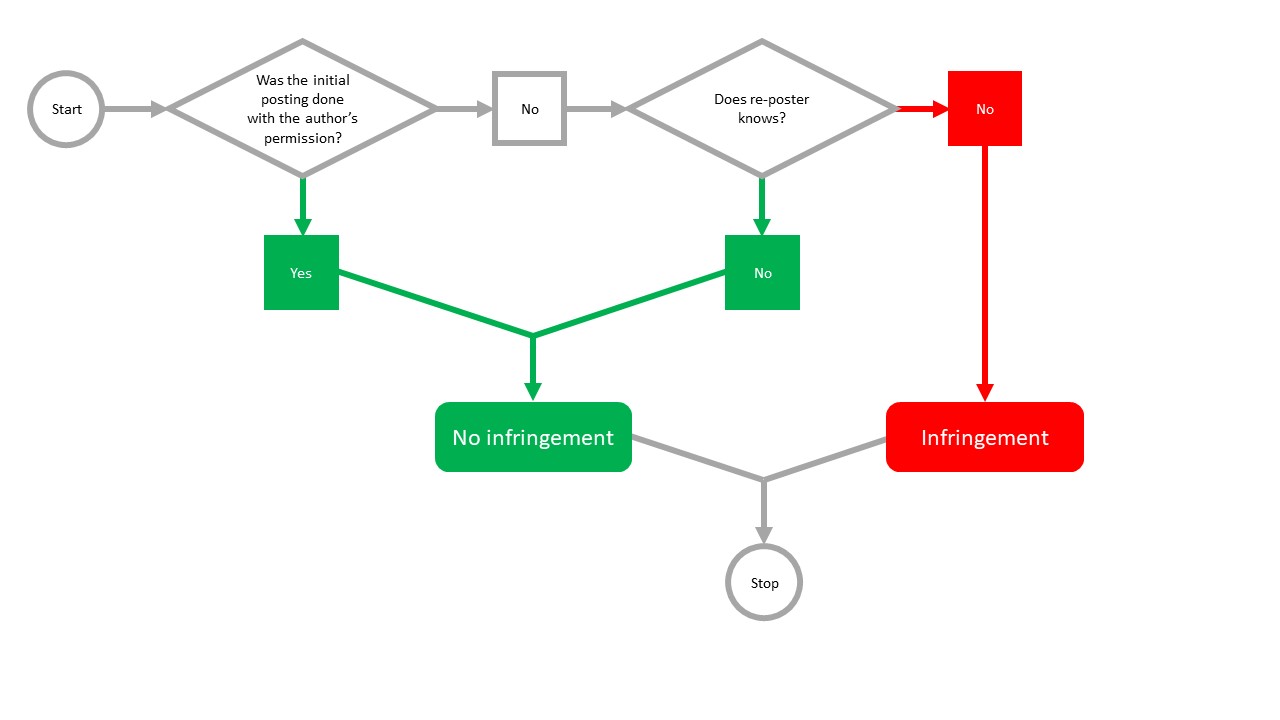
The main question for a user wanting to post a link is whether the initial posting was done with the copyright owner’s consent.

There is no infringement if the copyright owner gave permission for the original posting. There is no infringement either if the re-poster was unaware that the copyright owner did not grant permission. However, there is infringement id the re-poster is aware that the original post was done without consent of the copyright owner.
Decision workflow

How do I link to e-published articles?

How do I reference sources?

How do I find a legal version of an e-publication?

Why shouldn’t we link directly to PDFs?

Can I link to videos and films?

The author takes no responsibility for the content of this page, which is not intended as binding legal advice. The views are about copyright in the UK Higher Education sector context.

This website was created using Coventry.Domains, a service of the Coventry University Group. The information, views, opinions and discussion contained on this website are those of the author(s) and do not necessarily reflect the views and opinions of the Coventry University Group. For more information on privacy, cookies, takedown requests and more, visit our policies page.