Author: Erica Levi

The invention of the printing press

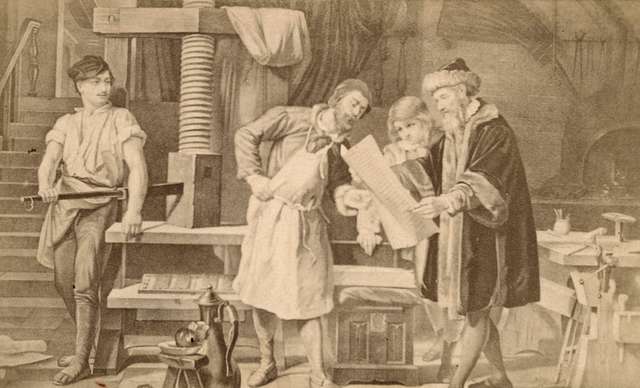
In the mid-15th Century, the German goldsmith Johannes Gutenberg invented the printing press. This was a new technology, and it marked the beginning of a new era: a single machine could produce almost 100 times faster any page that had been previously printed or copied by a solely dedicated person.

The printing press unlocked knowledge from being exclusively in the hands of a wealthy elite and the Church to be more widely available and affordable.


Go to next Letter Patents

Go Home

Image: Public Domain

The author takes no responsibility for the content of this page, which is not intended as binding legal advice. The views are about copyright in the UK Higher Education sector context.
Why shouldn’t we link directly to PDFs?

Links to PDFs change more frequently than a journal’s article landing page, for example. Therefore, linking directly to PDFs will cause links to break often, and the resources offered to students will be of high maintenance.

Unless copyright exceptions and licences permit it, the law will not allow you to redistribute the PDF freely to students.

What about hyperlinks and copyright?

How do I link to e-published articles?

How do I reference sources?

How do I find a legal version of an e-publication?

What about hyperlinks and copyright?

The author takes no responsibility for the content of this page, which is not intended as binding legal advice. The views are about copyright in the UK Higher Education sector context.
Notes on accessing newspaper articles online

Articles can generally be accessed on Locate when the library subscribes to the newspaper’s back issues.

Independent journalists write articles, but sometimes they aren’t available through subscriptions like the library’s. This may be due to the contract independent journalists have with that newspaper and the newspaper’s contract with that distribution platform.

Sometimes the newspaper makes the article available online for a while, but then has to take it down for contractual reasons.

It may be inconvenient, but that is how independent journalists earn a living and maintain their clout.

If the article is part of essential reading, you could try to seek permission from the journalist. Unfortunately, Coventry University doesn’t hold a Newspaper Licensing Agency (NLA) educational licence.

You may also try another avenue by asking a subject librarian if the article can be obtained through another licence, such as the CLA one.

Additionally, if a specific article previously openly available online is becoming fiddly to find, it is because it is in the process of being removed – search engines’ crawlers are still finding traces of it, but eventually, they will lose track – you might as well find an alternative resource to ensure longevity in the course (unless you obtain permission).

The author takes no responsibility for the content of this page, which is not intended as binding legal advice. The views are about copyright in the UK Higher Education sector context.
Can I include screenshots?

Can lesson content include screenshots from various websites used as a basis for teaching and activities?

Screenshots can be included (provided there is an acknowledgement) in the context of a module, where they are being used for instruction purposes, and they are unlikely to be a substantial part of the website as a whole.

In this context, it would be difficult to see how it could harm the company’s commercial interest.

Additionally, it would be permissible under fair dealing exceptions such as those for illustration for instruction or criticism and review.

The author takes no responsibility for the content of this page, which is not intended as binding legal advice. The views are about copyright in the UK Higher Education sector context.

How do I pick a Creative Commons licence for my work?

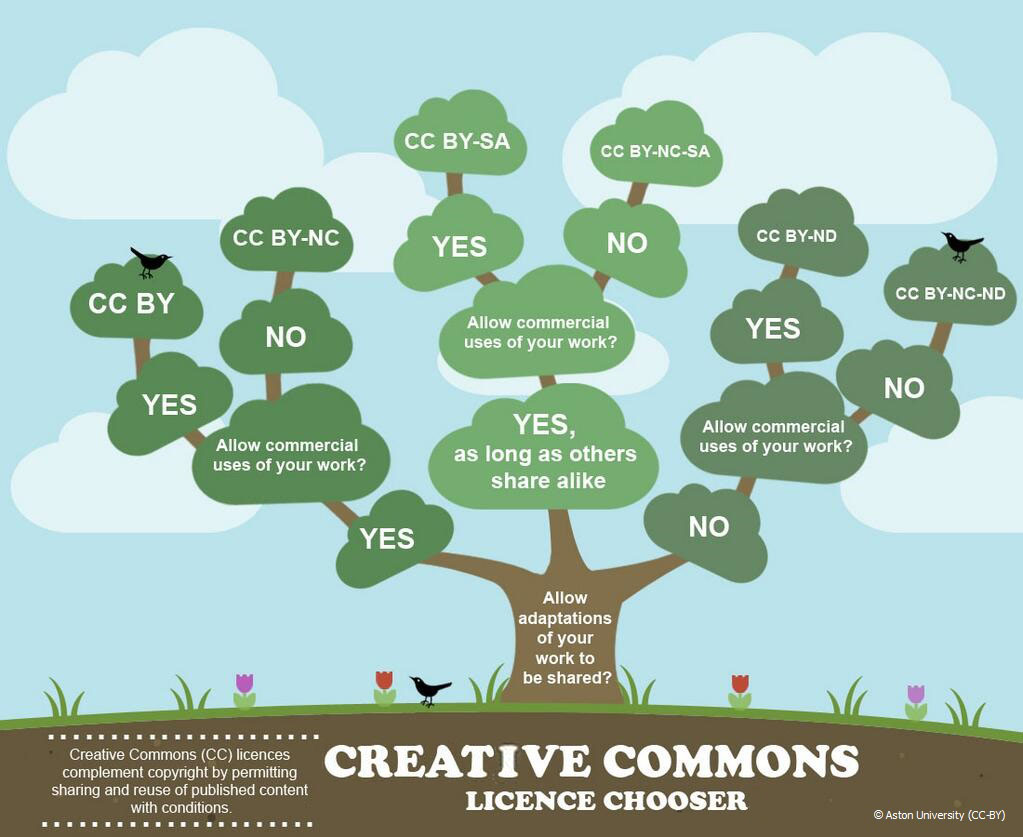
The colourful infographic from Aston University (licensed CC-BY) is a tree diagram explaining how creators can choose different Creative Commons licenses. It presents green leaves on the tree branches, a blue sky with clouds in the background, and a grassy ground with flowers. The overall design is friendly and visually appealing, making the information accessible and easy to understand. The image is titled "Creative Commons Licence Chooser” and briefly explains Creative Commons licences. It reads: "Creative Commons (CC) licences complement copyright by permitting sharing and reuse of published content with conditions." The Tree Diagram Structure has multiple branches, each representing a different Creative Commons licence. The branches split on whether the licence will allow commercial use and whether adaptations of the work are permitted. Each branch has green leaves with text indicating the licence type and answers to specific questions about the licence conditions. Starting from the trunk, the first question is, “Allow adaptations of your work to be shared?”. A positive answer will follow with a further question, “Allow commercial uses of your work?” if the chooser’s answer is positive, then the work will be licensed CC BY (Attribution); if it is negative, the licence will be CC BY-NC (Attribution-NonCommercial). If the answer to the first question, “Allow adaptations of your work to be shared?” was positive if others share alike, a further question will follow again to ascertain whether commercial uses of the work will be allowed: if the chooser’s answer is positive, then the work will be licensed CC BY-SA (Attribution-ShareAlike); if it is negative, the licence will be CC BY-NC-SA (Attribution-NonCommercial-ShareAlike). If the answer to the first question, “Allow adaptations of your work to be shared?” was negative, a further question will follow again to ascertain whether commercial uses of the work will be allowed: if the chooser’s answer is positive, then the work will be licensed CC BY-ND (Attribution-NoDerivs); if it is negative, the licence will be; CC BY-NC-ND (Attribution-NonCommercial-NoDerivs)

Please note that commonly, the Non-Derivative element (ND) of a Creative Commons licence makes the work released NOT with an open licence.

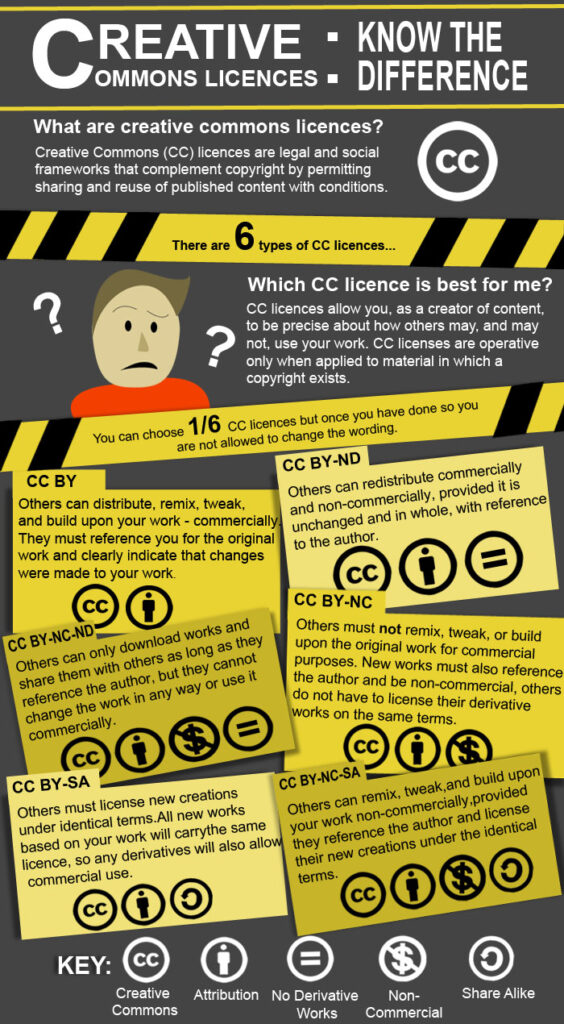
Find here a further infographic, also from Aston University:

The image is an infographic titled "Creative Commons Licences - Know the Difference". It explains Creative Commons (CC) licences, which allow content creators to specify how others can use their work. There are six types of CC licences: CC BY (it allows others to distribute, remix, tweak, and build upon the work, even commercially, as long as credit is given to the original creator); CC BY-SA (others can remix, tweak, and build upon the work even for commercial purposes, as long as they credit the creator and license new creations under identical terms); CC BY-ND (it allows for redistribution, commercial and non-commercial, as long as it is passed along unchanged and with credit to the creator); CC BY-NC (others can remix, tweak, and build upon the work non-commercially, and their new works must acknowledge the creator and be non-commercial; CC BY-NC-SA (others can remix, tweak, and build upon the work non-commercially, as long as they credit the creator and license new creations under identical terms; and CC BY-NC-ND (it allows others to download the works and share them with others as long as they credit the creator, but they can’t change them in any way or use them commercially). The infographic includes icons representing each licence type and conditions, such as Attribution, No Derivative Works, Non-Commercial, and Share Alike.

Forward to Considerations on remixed/adapted and derivative works for Creative Commons licensed material

Back to How do you reference and acknowledge Creative Commons licensed works?

Back to Creative Commons licences

Back to Open licences

Back Home

The author takes no responsibility for the content of this page, which is not intended as binding legal advice. The views are about copyright in the UK Higher Education sector context.

Creative Commons licences

Find here at a glance information on the Creative Commons:

1. What are the Creative Commons licences?
2. Fair dealing and the reuse of Creative Commons licensed works
3. What are the elements of the Creative Commons?
4. What are the six Creative Commons licences?
5. How do the Creative Commons licences work technically?
6. How do you reference and acknowledge Creative Commons licensed works?
7. How do I pick a Creative Commons licence for my work?
8. Considerations on remixed/adapted and derivative works for Creative Commons licensed material
9. Creative Commons’ adapters and remixers licence chart
10. How can I use works on Wikimedia and Wikipedia?

See also:

What are Open Educational Resources?

What is Open Access in scholarship?


Back to Open licences

Back to Licences

Back Home

The author takes no responsibility for the content of this page, which is not intended as binding legal advice. The views are about copyright in the UK Higher Education sector context.

Which licences does the Coventry University Group manage centrally?

Downloaded and scanned materials such as book chapters and journal articles is most likely subject to copyright restrictions. You may use Locate, the library catalogue, to discover the library’s holdings and obtain permalinks, or use closed-course access for quick access to resources.

However, some materials (for example, British Standards and Digimap) have territorial restrictions – students connecting from abroad cannot gain access. 

Please check with the Subject Librarian for updated information, including the licences below. 

  1. CLA licence
  2. Educational Recording Agency (ERA) Licence
  3. The university also subscribes to Box of Broadcasts (BoB), a service for UK universities that allows you to view and record TV or radio programmes on over 60 channels. Please check with the Subject Librarian for updated information on territorial restrictions.

The author takes no responsibility for the content of this page, which is not intended as binding legal advice. The views are about copyright in the UK Higher Education sector context.

3. Licences

Licences allow copyright owners to permit others to use the owned work. They can be exclusive, non-exclusive and open.

Licences should not be confused with the assignment of rights, where the copyright ownership is transferred from one entity to another.

The reuse of material has to fall within the terms allowed by the licence chosen by the copyright holder, apart from the following scenarios:

  1. As a user, you can justify the application of one of the copyright exceptions or
  2. The material is in the public domain and, hence, not subject to any licences.

Licenced material may be purchased through paid agreements (for example, through an institutional licence or contracts) or accessed for free if released to the public with an open licence or following an ad hoc permission granted by the copyright holder.

Look at the following categories to know more:

Can I use third-party-owned resources for teaching?
You might breach copyright law if you upload third-party-owned resources …
Which licences does the Coventry University Group manage centrally?
Downloaded and scanned materials such as book chapters and journal …

What are open licences?
A free or open licence is a licensing
agreement that allows individuals…

Back Home

The author takes no responsibility for the content of this page, which is not intended as binding legal advice. The views are about copyright in the UK Higher Education sector context.

1. Copyright overview

In this section, you will find information on copyright and the answers to common questions on the Law:

  1. What is Intellectual Property (IP)?
  2. Copying and creativity
  3. What is copyright?
  4. Copyright Law
  5. Exceptions in copyright
  6. What is copyrightable?
  7. Copyright advice
  8. University’s information and guidance

See Licences

Back Home

The author takes no responsibility for the content of this page, which is not intended as binding legal advice. The views are about copyright in the UK Higher Education sector context.

How do I find a legal version of an e-publication?

Some authors often upload their published version on ReseachGate and academia.edu when transferring their copyright to the publisher.

ReseachGate and academia.edu are commercial platforms, and most publishers do not allow authors to upload articles on those platforms because the existence of a published PDF online will cause them to lose income. There have been instances of publishers suing universities and authors for copyright breaches.

We cannot provide hyperlinks to documents posted on those platforms because linking to illegally posted sources online is unlawful.

So, what are the options?

  1. Check if the library has the publication. If it is a journal article, then if we subscribe, you can provide the DOI to the article (starting with http://dx.doi.org/…). If it is a book, you may provide the permalink from Locate.
  2. Find the publication on an institutional repository: a) look at the afflation of the authors. If it is from the UK or Europe and it is a post-2014 publication, likely, a version is legally deposited in the affiliated institutional repository; b) search on the browser for the name of the affiliation (e.g. “Coventry University”) plus the word ‘repository’. It will give you the link to the institutional repository; c) search for the title or author, and you may find the record and PDF; d) share that link openly.

What about hyperlinks and copyright?

How do I link to e-published articles?

Why shouldn’t we link directly to PDFs?

How do I reference sources?

What about hyperlinks and copyright?

The author takes no responsibility for the content of this page, which is not intended as binding legal advice. The views are about copyright in the UK Higher Education sector context.

This website was created using Coventry.Domains, a service of the Coventry University Group. The information, views, opinions and discussion contained on this website are those of the author(s) and do not necessarily reflect the views and opinions of the Coventry University Group. For more information on privacy, cookies, takedown requests and more, visit our policies page.