Tag: Remix

Creative Commons adapters and remixers licence chart

The following chart from the Creative Commons is a guide to ensure that adaptations comply with the licences’ terms.

The left-hand column identifies the licence of the original work to use in the adaptation.

By looking across the table, it shows the available licences for the new creation.

The table is titled "Adapter's licence chart" and details the compatibility of different licences for adapting works based on their original licence. It helps determine which licences are compatible for adapting works, ensuring proper usage and adherence to licensing terms. The table is organised with the "Status of original work" listed in the leftmost column and the "Adapter's licence" types listed across the top row. The intersections of these rows and columns are colour-coded to indicate compatibility: green cells represent permissible combinations, yellow cells represent permissible combinations with some restrictions, and grey cells represent combinations that are not allowed. Colour-coded details: for Public Domain as original work, all adapter licences are green; for  By Attribution as original work, it is green for BY, BY-NC, BY-NC-ND, BY-NC-SA, BY-SA, BY-ND and yellow for PD; for  By Attribution NonCommercial as original work, it is green for BY-NC, BY-NC-ND, BY-NC-SA and yellow for BY-NC, BY-ND, BY-SA, PD; for  By Attribution NonCommercial-NoDerivs as original work, it is grey for all adapter licences; for  By Attribution NonCommercial-ShareAlike as original work, it is green for BY-NC-SA only and grey for all other adapter licences; for By Attribution NoDerivs as original work, it is grey for all adapter licences; for By Attribution ShareAlike as original work, it is green for BY-SA only and grey is grey for all adapter licences.

CC does not recommend using a licence if the corresponding box is yellow, although doing so is technically permitted by the licence terms.
The grey boxes indicate those licences that one may not use as an adapter’s licence.

Examples:

  • If one adapts a BY-NC work, the BY-NC will do for the adaptation.
  • If one adapts a BY work, either BY or BY-NC will do for the adaptation.
  • Work licensed with BY-SA or BY-NC-SA must have the same licence applied for the adaptation.

Another type of licence compatibility relates to licences when remixing more than one pre-existing work.
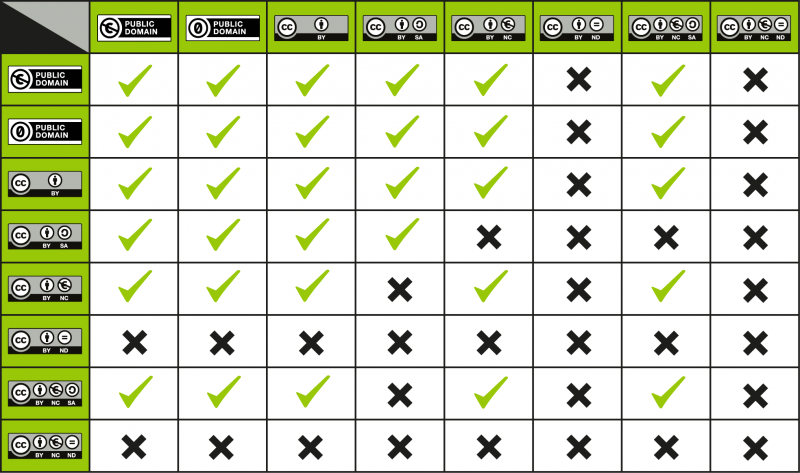
The chart helps users understand which Creative Commons licenses can be used together when mixing or reusing content under different licensing terms. The leftmost column lists different types of Creative Commons licenses, and the top row lists the same licenses. The intersections of these rows and columns indicate whether a specific combination of licenses is compatible, where each cell in the grid either has a checkmark (signifying that the combination of licenses is compatible) or a black "X (indicating that the combination of licenses is incompatible). In particular, Public Domain and CC BY (Attribution) are compatible with all but those with a NoDerivs element; CC BY-SA (Attribution-ShareAlike) is compatible with all but those with NonCommercial and NoDerivs elements; CC BY-NC (Attribution-NonCommercial) and CC BY-NC-SA (Attribution-NonCommercial-ShareAlike) are compatible with all but CC BY-SA (Attribution-ShareAlike) and those with a NoDerivs element; CC BY-ND Attribution-NoDerivs and CC BY-NC-ND Attribution-NonCommercial-NoDerivs are incompatible with any.

Find on the left column a licence of the works and match it with the one on the top to discover a licence that may apply to a second work:

  • A ‘tick’ at the intersection means that works under those two licences can be remixed.
  • An ‘X’ usually means the works may not be remixed.

When deciding on a licence to use for the adaptation, it is better to choose the more restrictive of the two licences on the works that are getting combined, to ease reuse for downstream users.


Forward to How can I use works on Wikimedia and Wikipedia?

Back to Considerations on remixed/adapted and derivative works for Creative Commons licensed material

Back to Creative Commons licences

Back to Open licences

Back Home

The author takes no responsibility for the content of this page, which is not intended as binding legal advice. The views are about copyright in the UK Higher Education sector context.

Considerations on remixed/adapted and derivative works for Creative Commons licensed material

An adaptation/remix brings together material from different sources to create a wholly new creation where one often cannot tell where one work ends, and another begins.

An example of an education adaptation would be an open textbook chapter that originates from multiple open educational resources in such a way that readers cannot tell which resource was used on which page without looking at endnotes

  • In all cases, one has to attribute the original work when you create an adaptation. It is important to provide attribution to the individual parts that went into making the adaptation.
  • If the original work was licensed under a NoDerivatives licence 4.0, one can make and use changes privately but cannot share it with others.
  • One has to check licence compatibility to verify which types of licensed works can be adapted into a new work; for example, if the original work was licensed under a ShareAlike licence, one can only license the new work with the same or a compatible licence (see here).

When creating an adaptation of a CC-licensed work, the simplest scenario is when one takes a single CC-licensed work and adapts it.

The more complicated scenario is when one is adapting two or more CC-licensed works into a new work. The Adapter’s Licence has to consider the original licence that will continue to govern the reuse of the elements from the original work.


Forward to Creative Commons’ adapters and remixers licence chart

Back to How do I pick a Creative Commons licence for my work?

Back to Creative Commons licences

Back to Open licences

Back Home

The author takes no responsibility for the content of this page, which is not intended as binding legal advice. The views are about copyright in the UK Higher Education sector context.

This website was created using Coventry.Domains, a service of the Coventry University Group. The information, views, opinions and discussion contained on this website are those of the author(s) and do not necessarily reflect the views and opinions of the Coventry University Group. For more information on privacy, cookies, takedown requests and more, visit our policies page.